|
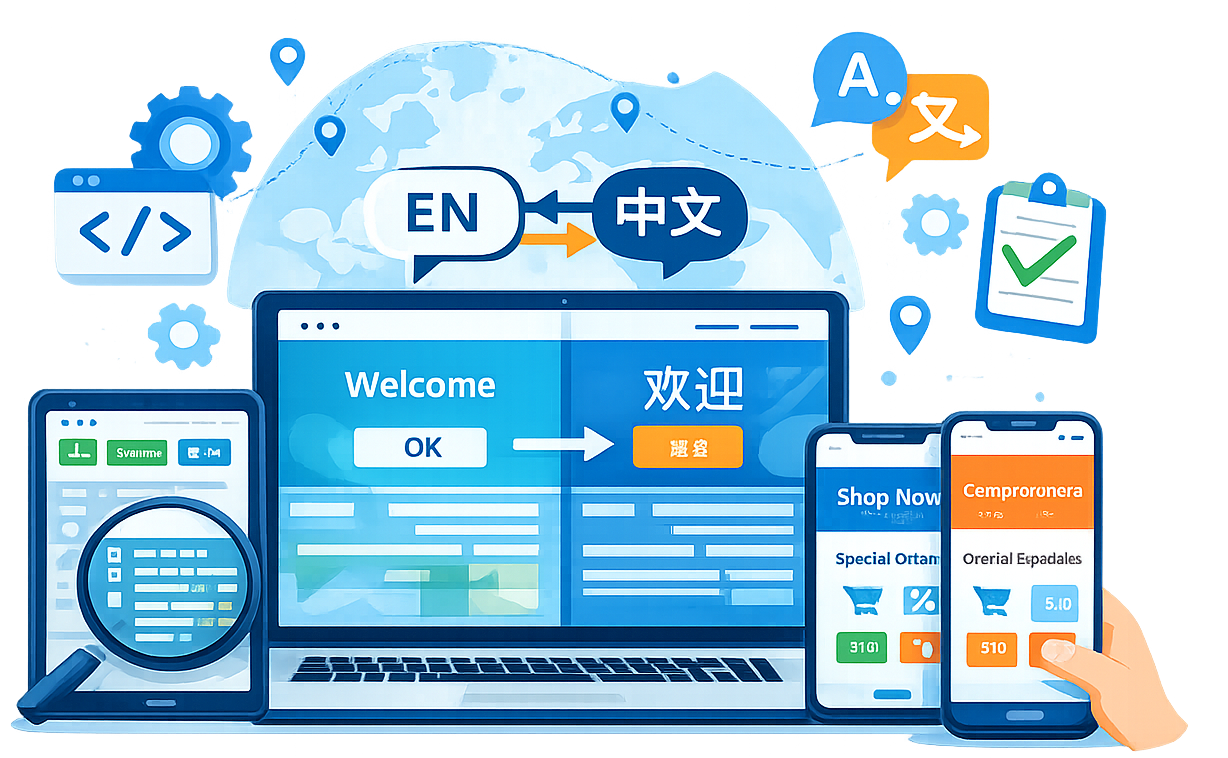
The Strategic Pillars of Software Localization Whether your content lives inside resource files, app stores, SDK-driven environments, or continuous deployment pipelines, we adapt to your technical architecture. Our localization workflows integrate smoothly into your release cycles — without disrupting development, QA, or product velocity. |

|
At Alafranga, More than a vendor. At Alafranga, we treat software strings the way developers treat code — with version control, placeholder protection, and QA validation before every release. Your project manager coordinates linguists, file engineering, and delivery without interrupting your workflow. |

▮What We Typically Localize
- Mobile app UI (iOS & Android string files)
- Menus, navigation systems, and micro-interactions
- Onboarding flows and in-app tutorials
- Push notifications and in-app messages
- Subscription flows and payment screens
- App Store / Google Play descriptions and metadata
- Release notes and version updates
- Help sections and support content
- Embedded legal content (privacy, terms, permissions)
▮Let’s localize your app without slowing releases
Tell us:
- your app architecture (iOS, Android, cross-platform framework),
- file formats (.strings, XML, JSON, RESX, etc.),
- target markets and languages,
- release cadence (sprints, version cycles, live updates),
- and which features are compliance-sensitive (payments, legal, permissions) vs high-volume
We'll propose the right workflow design, QA depth, terminology governance, in-context validation, and delivery format. — so your product can scale globally without breaking velocity.
- What is software localization and how is it different from translation? Software localization is the adaptation of a software product — its interface, content, and behaviour — for a specific market. It goes beyond translation. A localized app handles text expansion without breaking layouts, protects placeholders and variables from accidental modification, adapts store listings for local search visibility, and ensures compliance-sensitive content such as permissions and subscription disclosures meets local regulatory expectations. Translation is one part of this process — localization is the whole.
- Which software and app content do you localize? We localize the full range of software content — mobile app UI for iOS and Android, menus, navigation systems, onboarding flows, in-app tutorials, push notifications, in-app messages, subscription flows, payment screens, App Store and Google Play descriptions, release notes, help sections, support content, and embedded legal content such as privacy policies, terms, and permissions. We also localize developer documentation, API references, SDK guides, and release notes.
- How do you handle placeholders, variables, and tags in software strings? Placeholders, variables, string IDs, and formatting tags are treated as protected elements throughout the localization workflow. CAT tool validation rules prevent accidental modification. Tags are checked automatically on export. For apps with complex string architectures — concatenations, pluralization rules, character limits, and system-triggered messages — we apply additional QA controls before delivery. We also perform in-context validation to catch truncation, overflow, and broken UI elements before release.
- Can you integrate with our development workflow and CI/CD pipeline? Yes. We work natively with standard software localization file formats — .strings, XML, JSON, RESX, PO, YAML, XLIFF, and others. For teams with continuous deployment cycles, we can connect directly to your repository or localization platform to ensure translations are always synchronized with your release schedule. We adapt to your sprint cadence, version cycles, and live update frequency — without requiring changes to your existing architecture.
- Do you offer Turkish software localization? Yes. Turkish is our founding language pair — active since 2002. Turkish software localization requires specific technical knowledge — agglutinative morphology means Turkish UI strings are often significantly longer than their English source, creating text expansion issues in fixed-width components. Turkish also has distinct character set requirements including dotted and dotless i variants that must be handled correctly in all file types. We deliver Turkish software localization with character-level precision and terminology governance across all content types.