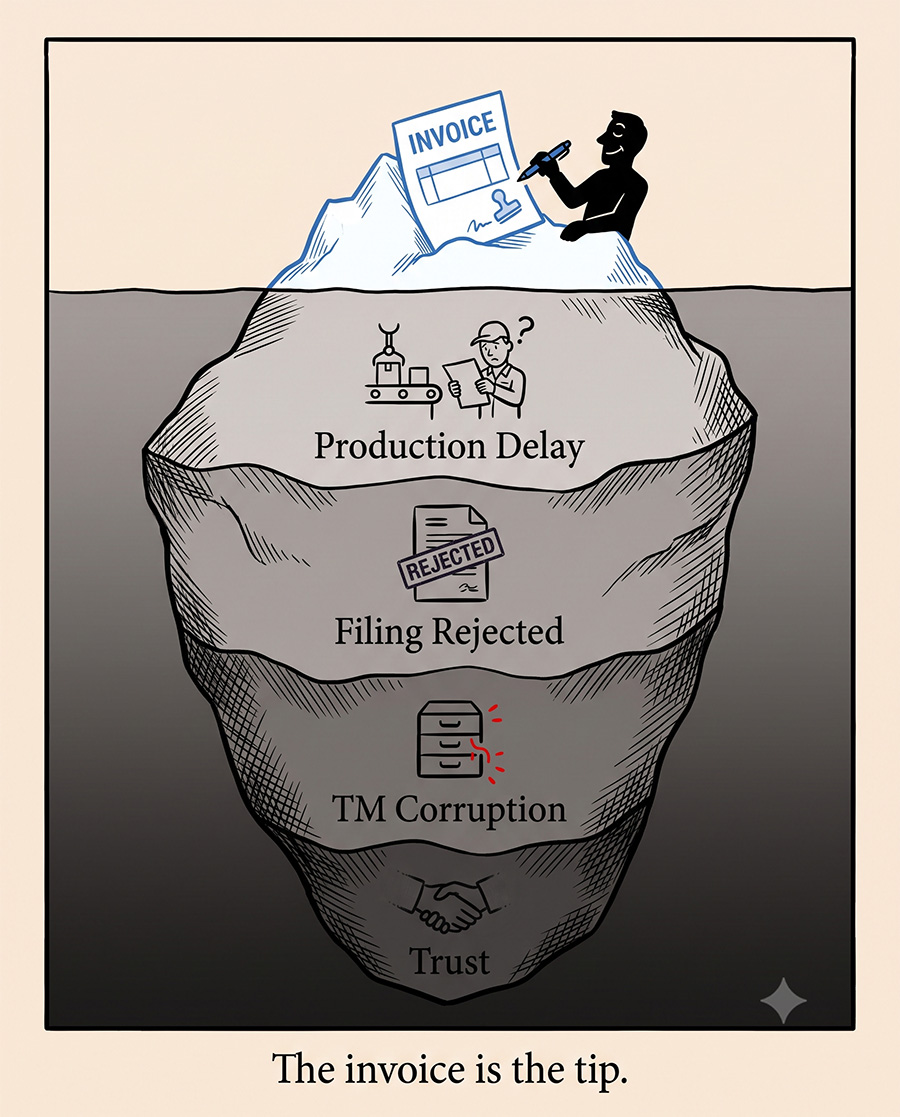
The Real Cost of a Cheap Translation Is Never on the InvoiceEvery procurement decision starts with the same number: the quote. Ten cents a word versus eighteen. A cheap translation and a properly resourced one can look identical on paper, both delivered, both invoiced, both filed away.
The difference shows up later, in places nobody thought to check when the invoice was approved. Twenty-three years of watching technical documentation move through production has taught me that the real cost of a translation is rarely the fee. It is what happens after delivery, when the translation turns out to be wrong in a way nobody caught in time.
By Volkan Güvenç, Founder & Director
 |
The examples below are not case studies of specific clients. They are patterns, the kind that recur across the industry closely enough that most people in technical documentation, procurement or compliance will recognise at least one from their own experience.
Cost One: Production Stops on the FloorConsider a manufacturer shipping an industrial machine to a distributor in a market where the installation manual has been translated at the lowest quote available. The manual is fluent. It is also wrong in one place: a torque specification rendered with the wrong unit, or a valve labelled with a term the maintenance team has never seen used that way.
|
The installation team follows the manual. Something does not fit, or fits wrong. Work stops while someone calls the manufacturer to ask what the instruction actually meant. If the machine is expensive enough or the installation window tight enough, a technician gets on a plane.
The translation fee for that manual might have been a few hundred euros below a properly resourced quote. The cost of one stalled installation, one emergency call, one flight, dwarfs the saving many times over. Nobody records this against the translation budget. It shows up in a field service report, in a different department's costs, disconnected from the decision that caused it.
Cost Two: The Filing Gets RejectedRegulatory documents carry a different kind of risk, because the failure is not gradual, it is binary. A declaration of conformity either matches the expected legal formula in the target language or it does not. A CE technical file either uses the terminology a market surveillance authority recognises or it raises a flag.
|
A translation produced without knowledge of the applicable regulation can read perfectly well and still fail this test. The sentence is grammatically correct. It is also not the sentence the regulation requires. When that gets caught during a market surveillance check rather than before shipment, the consequence is not a translation redo. It is a product held at customs, a compliance deadline missed, or in the more serious cases, a formal notice requiring a corrected filing before further sales in that market can proceed.
With the EU Machinery Regulation 2023/1230 taking effect on 20 January 2027, this particular failure mode is about to become far more common, because every manufacturer's declaration of conformity needs to be rewritten against a legal text most translators have never worked with.
Cost Three: The Bad Translation Never LeavesTranslation memory is supposed to be an asset. It saves money on every subsequent update, because previously translated content does not need retranslating from scratch.
|
This only works if what went into the memory was correct. A rushed, low-cost translation that entered a client's translation memory five years ago does not disappear when a better provider is hired later. It sits there as a high-percentage match, quietly suggesting itself for reuse on every future project, because to a matching algorithm, a fluent sentence and a correct sentence look identical.
I have seen manufacturers pay to have a new provider retranslate a document, only to discover the real cost was not the retranslation. It was the audit: someone had to read through years of accumulated translation memory to find every instance where the old, subtly wrong terminology had been quietly propagating itself into new manuals. That audit costs more than the original saving ever was.
Cost Four: Nobody Trusts the Document AnymoreTranslation memory is supposed to be an asset. It saves money on every subsequent update, because previously translated content does not need retranslating from scratch.
|
The least measurable cost is also, in my experience, the most corrosive. A distributor who receives one manual with confusing translation starts reading every subsequent manual from that manufacturer more skeptically. A regulator who catches one formatting error in a declaration of conformity looks harder at the next filing. An end customer who cannot follow a user manual calls support instead of solving the problem themselves, and forms an opinion about the product's overall quality that has nothing to do with engineering.
None of this appears on an invoice. All of it affects how much a manufacturer's documentation, and by extension its product, is trusted going forward.
What the Real Number Looks LikeThe quote on a translation invoice is one number in a longer equation: invoice cost, plus the cost of any operational disruption the translation causes, plus the cost of correcting or auditing it later, plus whatever the relationship or reputational damage is worth. Most procurement decisions only see the first number.
|
This is not an argument for paying the highest quote available. Overpaying is its own inefficiency. It is an argument for asking what a quote actually includes before comparing it to another: is there independent review, does the translator have relevant subject-matter background, is terminology managed and audited, is there a process for catching the kind of error that looks fine on the page and fails in the field.
A cheap quote and a properly resourced one both produce a document. Only one of them reliably produces a document that holds up after delivery. The difference rarely shows up where the budget was approved. It shows up later, somewhere else in the business, attached to a cost nobody thought to trace back to the translation decision that caused it.
Further readings:
Why Translating from English into Turkish Is Harder Than Most Briefs Assume
Why Turkish Is Not Just Another European Language for Technical Translation
When Terminology Inconsistency Becomes a Real-World Problem
Why Turkish Legal Translation Demands Ongoing Legal Literacy
How to Choose a Turkish Translation Partner for Technical Documentation
Turkish Legal Translation Services
How to Get a Legal Turkish-to-English Translation: A Step-by-Step Guide
Turkey Has No National Translator Certification: Here Is What Buyers Should Know