|
Why Turkish Is Not Just Another European Language for Technical Translation
By Volkan Güvenç, Founder — Alafranga Language Solutions
 Most European language combinations follow a familiar pattern. The project manager sends the source file, the translator works through it, a reviewer checks it, and the document comes back. The workflow is predictable because the languages behave predictably — similar sentence structures, overlapping terminology traditions, shared Latin script.
|
Turkish does not behave predictably by those standards. And if you've ever received a Turkish translation that looked fine on screen but caused problems in layout, confused readers in the field, or failed regulatory review, Turkish linguistics is likely where the problem started — not the translator.
I've been working with Turkish technical content since 2002. These are the things I wish more project managers and procurement teams understood before commissioning Turkish translation.
|
Turkish is agglutinative. That changes everything.
English and most Western European languages build meaning through word order and separate function words. Turkish builds meaning by adding suffixes to a root — sometimes many suffixes in a single word. The result is that a phrase taking five or six words in English may compress into two in Turkish, or expand into twelve, depending on what needs to be expressed.
|
A few technical examples that illustrate the scope of this:
| English | Turkish | Notes |
| operating instructions | kullanım kılavuzu | Standard; similar length |
| it cannot be disconnected from the power supply | güç kaynağından bağlantısı kesilemez | 6 English words → 4 Turkish words |
| do not operate without reading the safety instructions | güvenlik talimatlarını okumadan çalıştırmayınız | 8 English words → 4 Turkish words |
| it should not be used by unauthorised personnel | yetkisiz personel tarafından kullanılmamalıdır | suffix chain encodes the entire clause |
| maximum permissible operating temperature | izin verilen maksimum çalışma sıcaklığı | similar length, but word order inverted |
This is not a minor stylistic difference. It has direct consequences for technical content:
Software UI and interfaces. A button label reading "Save and Continue" in English might become "Kaydet ve Devam Et" — manageable. But "Disconnect from Network" becomes "Ağ Bağlantısını Kes", and "Enable automatic synchronisation" becomes "Otomatik eşitlemeyi etkinleştir" — a single compound verb that is longer than the UI field was designed to hold. String tables written without Turkish in mind require rework at the development level, not just the translation level.
Safety warnings and instructional text. Technical writers in English use short imperatives: "Press the red button." In Turkish, grammar naturally integrates context into the verb, producing longer but grammatically correct constructions — "Kırmızı düğmeye basınız" — that clients sometimes flag as over-translation. The longer form is not an error. Forcing Turkish into English sentence counts usually is.
Negative constructions. Turkish expresses negation through a suffix on the verb, not a separate word. "Do not press" becomes "basmayınız" — a single word. In a warning label, this compresses well. But in a multi-condition safety instruction, chains of negative suffixes can make the sentence structurally complex in ways that require careful review by a specialist, not just a bilingual proofreader.
|
Turkish technical vocabulary is not settled
Western European languages have centuries of technical terminology development, standardised through industry bodies, academic institutions, and international standards organisations. Turkish has developed its modern technical vocabulary rapidly — much of it during the industrialisation period of the mid-twentieth century, and again during the technology adoption wave of the 1990s and 2000s.
|
The result is that multiple terms often coexist for the same concept, with different terms preferred by different industries, regions, or generations of practitioners.
Some examples from fields we work in regularly:
| Concept | Term 1 | Term 2 | Context |
| software | yazılım | program | yazılım is standard in formal and regulatory contexts; program is common in everyday use |
| hardware | donanım | hardver | donanım is preferred in formal documentation; hardver appears in informal technical speech |
| calibration | kalibrasyon | ayar | kalibrasyon for metrology and ISO contexts; ayar for general settings |
| maintenance | bakım | idame | bakım is universal; idame is used in defence and military contexts |
| specification | teknik şartname | spesifikasyon | teknik şartname in procurement and tendering; spesifikasyon in engineering documentation |
| torque | tork | döndürme | momenti tork in automotive; döndürme momenti in mechanical engineering manuals |
| inverter | invertör | evirici | invertör used commercially; evirici in Turkish Standards Institute (TSE) documentation |
For safety-critical content — machinery instructions, pharmaceutical labelling, electrical installation guides — this is not an academic concern. A technician reading a maintenance manual in a factory in Bursa expects the same terminology he sees on the machine panel. If the manual uses "evirici" and the panel label says "invertör", the mismatch creates friction at best, and safety risk at worst.
Our approach is to build and maintain client-specific terminology glossaries that reflect the vocabulary actually used by the end user's industry and region. This takes time to establish on a new account, but it is the only reliable way to produce Turkish technical content that works in context.
|
The Turkish character set is a recurring production problem
Turkish uses six characters that do not exist in the standard Latin character set: ç, ğ, ı, ö, ş, ü — and their capitals Ç, Ğ, İ, Ö, Ş, Ü. Note in particular the dotless ı (lowercase) and dotted İ (uppercase) — a distinction that does not exist in any other Latin-script language and trips up automated systems routinely.
|
The practical problems this creates:
Encoding errors. Documents processed through systems defaulting to ISO 8859-1 instead of UTF-8 or Windows-1254 (the Turkish code page) produce garbled output: "kalibrasyon" becomes "kalibrasyon", "şartname" becomes "\u015fartname" or worse. This is a production quality issue, not a translation quality issue — but the client sees it as a broken document.
Automated indexing and search. A PDF technical manual with a Turkish index requires explicit configuration for Turkish alphabetical order. In Turkish, the sort order is: a, b, c, ç, d, e, f, g, ğ, h, ı, i, İ, j, k, l, m, n, o, ö, p, r, s, ş, t, u, ü, v, y, z. Software that treats ı and i as the same character, or that sorts ş after s as a simple variant, produces an index that Turkish readers find disorienting or unusable.
Font compatibility. Not all fonts include the full Turkish character set. A document produced in a sans-serif font that handles ğ and ş correctly may render correctly on screen and break in print, or vice versa. DTP teams that have not worked on Turkish content regularly miss this until it is too late in the production cycle.
Spell-check and QA tools. Translation QA software applies spell-check during review. Without Turkish language packs correctly configured, Turkish text will generate hundreds of false-positive errors — drowning out genuine issues in noise. A QA pass that is not configured for Turkish is effectively no QA pass at all.
|
Two registers of Turkish exist in parallel — and they are not interchangeable
There is a meaningful difference between formal written Turkish — appropriate for legal documents, technical manuals, regulatory filings, and official communications — and the more direct register used in software interfaces, user guides, and consumer-facing content.
|
In formal Turkish, the second-person instruction typically uses the plural imperative: "Lütfen formu doldurunuz" (Please complete the form). In a software UI or a modern consumer product guide, this sounds stiff; the simple imperative "Formu doldurun" is more appropriate. Both are grammatically correct. Neither is interchangeable with the other in context.
Regulatory content for the Turkish market — in particular, CE-marked machinery documentation required under Turkish market access rules — typically expects formal register throughout. A translation produced in a more conversational register may be technically accurate and still be flagged during compliance review.
This distinction is not always visible to a project manager reviewing a translation without Turkish language expertise. It requires a reviewer who knows not just Turkish, but the register norms of the specific content type.
|
Right-to-left adjacency is a common layout trap
Turkish is written left-to-right, so desktop publishing teams working on multilingual documents sometimes don't flag it for special layout attention. The assumption is that Arabic and Hebrew need careful handling, but Turkish will fit into a standard European template.
|
This assumption fails for a different reason: Turkish text frequently appears in the same documents as Arabic in Middle Eastern-facing materials, or as part of multilingual layouts where the overall design was built around shorter Germanic or Romance language strings.
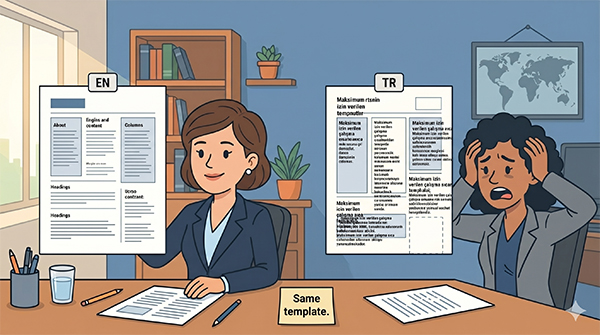
When Turkish text expands significantly relative to the source — which happens regularly given the agglutinative structure — it breaks layouts that were not built with text expansion in mind. Consider:
| English source | Turkish translation | Expansion |
| Operating manual | Kullanım ve bakım kılavuzu | +60% |
| Safety warnings | Güvenlik uyarıları | similar |
| Do not touch | Dokunmayınız | +40% |
| Electrical hazard — disconnect before servicing | Elektrik tehlikesi — bakım öncesinde bağlantıyı kesiniz | +35% |
We handle DTP for translated Turkish content as a standard part of our workflow. In our experience, documents that look clean in English or German require meaningful layout intervention after Turkish translation in roughly one in three projects.
|
What this means if you're commissioning Turkish translation
These are not reasons to avoid Turkish translation, or to treat it as more expensive by default. They are reasons to work with a team that has handled enough Turkish technical content to have developed practical answers to these problems.
|
Some questions worth asking your current or prospective translation partner:
Do they maintain client-specific Turkish glossaries, or do they rely on generic terminology databases? How do they handle software localisation string length constraints for Turkish? Do their QA tools have Turkish language packs correctly configured? Do they have Turkish-native reviewers with subject matter background, not just language background? Can they handle DTP for Turkish-language output, including character encoding and layout adjustment?
If those questions are difficult to answer, the translation may be technically correct and still cause problems downstream.
We have been working in Turkish technical translation since 2002 — across industrial equipment manuals, energy sector documentation, software interfaces, legal content, and pharmaceutical materials. The linguistic challenges that make Turkish technically demanding have not changed. The tools for managing them have improved. The need for specialist knowledge has not.
If you are working on documentation that will reach Turkish-speaking engineers, technicians, procurement teams, or end users, we are happy to discuss the specifics of your content.