AI-Assisted Translation with Human Review
The first draft is machine-made. Every decision after that is a translator's.
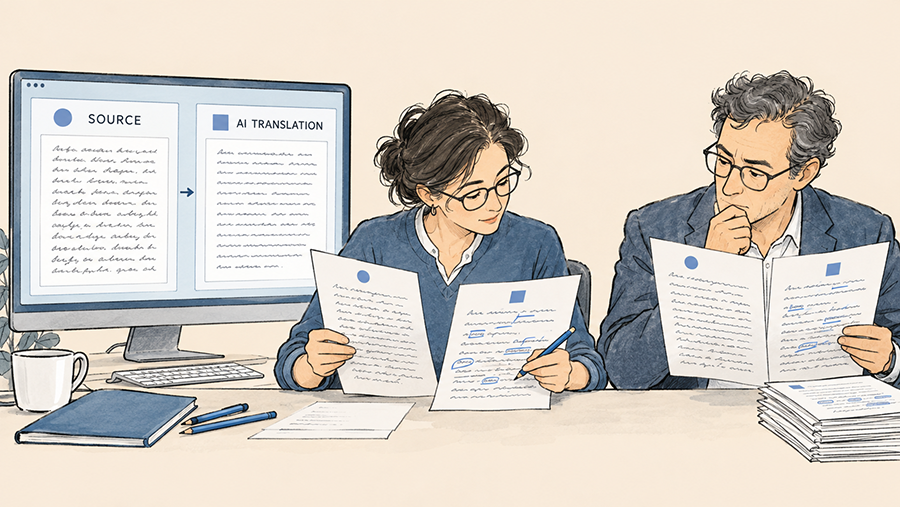
SmartEdit and SmartEdit Pro are our AI-assisted workflows. A machine translation engine (DeepL, GPT or Claude, selected per language pair and content type) produces the first draft inside memoQ or Trados, working against your translation memory and approved glossary. From that point, qualified translators take over. While additional quality steps can be added when required, we generally recommend two core approaches:
AI Draft + Human Post-Editing
Machine draft, followed by full post-editing by a qualified professional translator who checks every segment against the source, the terminology and your style requirements. This is our SmartEdit workflow.
AI Draft + Human Post-Editing + Independent Review + Final QA
Machine draft, full post-editing by a qualified translator, an independent review by a second qualified linguist, and a final quality assurance check. This is our SmartEdit Pro workflow.
|

▮Where the AI Draft Breaks in Turkish
- Dropped subjects
Turkish allows the subject to be omitted. AI drafts frequently omit it where the source sentence has a specific actor, and the instruction becomes ambiguous about who performs the action. In safety and maintenance content this is not a style issue. - Long source sentences left intact
English technical writing chains relative clauses. Turkish is agglutinative and left-branching, so the same structure produces a sentence the reader has to reconstruct backwards. The draft is not wrong, it is unusable. It has to be split. - Terminology drift between TSE and EU sources
- Many technical terms have one form in Turkish standards and another in EU-derived documentation. The AI picks whichever is more frequent online. Which one is correct depends on where your document is going, and that is a decision, not a lookup.
- Register collapse in the second person
Turkish marks formality. Drafts move between formal and informal address inside the same document, especially in UI strings and user manuals. - English compound nouns
Three-word compounds get rendered word by word instead of resolved into the established Turkish term, if one exists.
- Asset preparation. Glossary, translation memory, and reference material loaded before anything is generated.
- AI draft. Generated inside memoQ or SDL Trados through an API connection, not as a standalone tool, with your TM and glossary applied from the first segment.
- Specialist review. Every segment read and corrected by a translator working in their subject area.
- Automated QA. Tags, placeholders, numbers, units, and formatting checked.
- Delivery. Files returned in your working format, with the TM and glossary updated for your nxt project.
What we quote most
| Steps | SmartEdit | SmartEdit Pro |
| Feasibility check on your content | ● | ● |
| Briefing and asset preparation | ● | ● |
| AI draft inside memoQ or Trados, with your TM and glossary | ● | ● |
| Full post-editing by a subject specialist | ● | ● |
| Post-editor's own check | ● | ● |
| Automated QA | ● | ● |
| Independent revision, second specialist | ● | |
| Final QA before release | ● | |
| Domain review | on request | on request |
| Proofreading before publication | on request | on request |
| TM and glossary updated and returned | ● | ● |
▮Questions We Hear Before Every Project
Is my content used to train AI models?
No. Drafts are generated through paid API connections whose terms exclude submitted content from model training. Your text never goes into public chat tools. If your contract or NDA does not allow any third-party AI processing, tell us and we will quote the fully human workflow instead.
Will you tell me when AI was used?
Yes. The workflow is named on the quote, the order confirmation and the delivery note. We do not deliver AI-drafted work as human translation.
How much cheaper is SmartEdit than human translation?
It depends on the file, so we quote after the feasibility check rather than from a fixed discount table. Well-structured technical content with a good translation memory saves the most. Poor source text, unsettled terminology or a difficult language pair can reduce the saving to nothing. In that case, we recommend HumanExpert.
Does SmartEdit conform to ISO 17100?
No. ISO 17100 covers human translation, and we do not claim conformity for machine-drafted text. Both SmartEdit workflows run under our quality management system aligned with ISO 17100:2015. If your procurement requires ISO 17100 conformity, the right workflow is HumanExpert Pro. A new ISO standard to integrating human translation and AI processing is currently under preparation.
Can I choose or exclude an AI engine?
Yes. We normally select the engine per language pair and content type. If your company approves or excludes a specific provider, we work within that policy.
Can you post-edit AI translation we have already produced?
Yes, after the same feasibility check. We review a sample first, because output generated without your translation memory and glossary often needs more work than a new draft produced inside memoQ or Trados. read more..
Does SmartEdit work for languages other than Turkish?
Yes, across our 40+ languages. Draft quality varies by language pair, so the feasibility check matters more for some pairs than others.
We have no translation memory or glossary. Can we still use SmartEdit?
Yes. We extract the key terminology from your content and agree it with you before drafting starts. The first project needs more post-editing time than later ones. Each delivery adds to your translation memory and glossary for the next one.
Who owns the translation memory?
You do. The translation memory and glossary built on your projects are returned with each delivery, and you can take them to any other supplier.