Why a UK Certified Translation Might Not Work in Germany (And What Does)A client asked me last month why the certified translation we prepared in London was rejected by a court in Munich. The translation was accurate. The certification was genuine. The problem was that Germany does not recognise UK certification for court filings, and nobody had told them that before the document was submitted.
By Volkan Güvenç, Founder & Director 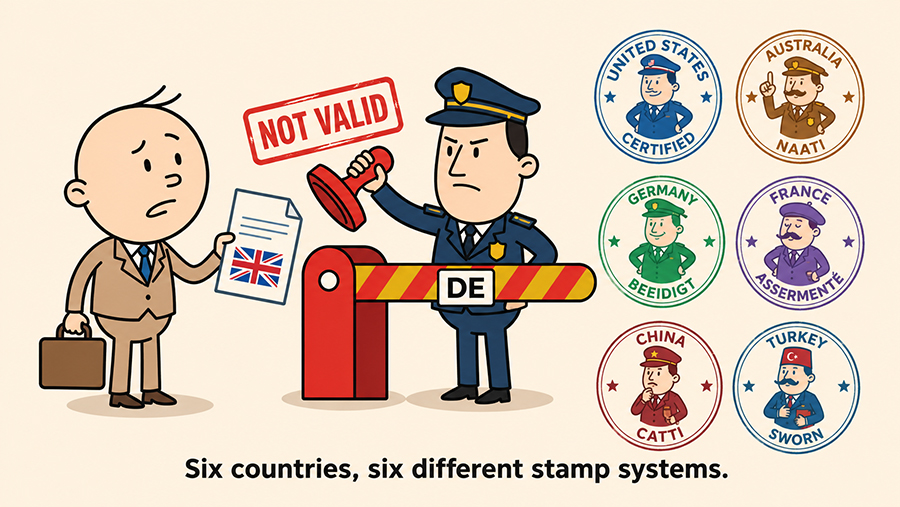 |
This happens more often than it should, and it is entirely avoidable. Here is what every buyer of legal translation in Europe needs to understand before ordering a certified or sworn translation.
There Is No EU-Wide CertificationMany buyers assume that because the EU has harmonised so much regulation, translator certification must be harmonised too. It is not. There is no EU-wide sworn translator register and no single European certifying body. Each country runs its own system, built on its own legal tradition, and a certification valid in one country carries no automatic weight in another.
|
This surprises people because most other professional certifications in Europe have moved toward mutual recognition. Translation has not. A translator authorised by a German court has no special status in France. A sworn translator registered in Turkey has no special status in Germany, unless the specific document type and destination authority accept it through other means such as an apostille.
How the Major Systems Actually WorkMany buyers assume that because the EU has harmonised so much regulation, translator certification must be harmonised too. It is not. There is no EU-wide sworn translator register and no single European certifying body. Each country runs its own system, built on its own legal tradition, and a certification valid in one country carries no automatic weight in another.
|
United Kingdom. There is no state register of sworn translators. UK courts, universities, and government bodies accept translations certified by a member company of the ATC (Association of Translation Companies) or by translators holding recognised professional credentials. This is a lighter-touch system than most of continental Europe, and it works well for UK-bound documents. It does not extend abroad.
Germany. German courts and public authorities generally require a translator who has been sworn in and authorised by a German regional court (beeidigter or ermächtigter Übersetzer, depending on the federal state). This authorisation is granted after an examination or proof of qualification, and it is tied to a specific court. A translation certified anywhere else, however professionally produced, is often not accepted for German court filings.
France. France requires a traducteur assermenté, registered with a Court of Appeal (Cour d'Appel). The list is public and the appointment process is rigorous. As in Germany, the authorisation is jurisdiction-specific.
Spain. Spain uses the traductor jurado system, with appointments made by the Ministry of Foreign Affairs. The requirement applies to official documents submitted to Spanish public bodies.
Italy. Italy does not have a single national sworn translator register in the same sense. Instead, translations are formally validated through a court procedure called asseverazione, where the translator swears an oath before a court official for each specific translation.
Turkey. Sworn translator status (yeminli tercüman) is granted through registration with a specific Turkish notary. Official submissions in Turkey typically require both sworn translation and notarisation. For documents intended for use abroad, an apostille is often added.
Six countries, six different systems, six different answers to the question "who is allowed to certify this."
Where the Apostille FitsThe Hague Apostille Convention is the one mechanism that genuinely crosses borders. An apostille is an authentication stamp issued by a competent authority in the country where a document originates, and it is recognised by all other signatory countries without further legalisation.
|
For many document types, a translation notarised and apostilled in Turkey is accepted across a wide range of EU member states. This is often the fastest and most economical route for personal certificates, company registry extracts, and powers of attorney.
It is not universal. Some receiving authorities, particularly certain German courts for specific filing types, still insist on a translator authorised within their own jurisdiction regardless of apostille. The apostille authenticates the origin of the document. It does not override a destination country's rules about who is qualified to translate it. Whether it is sufficient depends on the specific receiving authority, and that is worth confirming before you commission the work, not after.
Most Business Content Does Not Need Any of ThisThe Hague Apostille Convention is the one mechanism that genuinely crosses borders. An apostille is an authentication stamp issued by a competent authority in the country where a document originates, and it is recognised by all other signatory countries without further legalisation.
|
Here is what gets lost in conversations about certification: the overwhelming majority of B2B translation work does not require certification at all.
CE technical files, user manuals, safety documentation, and installation guides fall under EU machinery and product legislation, which requires the content to be provided in the language of the destination market. It does not require a sworn or certified translator. Responsibility for accuracy rests with the manufacturer, not with a notarised signature.
Commercial contracts are usually translated for internal understanding, negotiation, or reference. Unless a specific clause or jurisdiction requires certification, the parties rely on the governing language version of the contract, and the translation serves a practical rather than a legal-authentication purpose.
The same applies to compliance documentation, marketing content, software strings, and most corporate communication. What this content needs is accuracy, consistent terminology, and a documented quality process. Not a stamp.
Confusing these two categories costs buyers real time and money. I have seen procurement teams request sworn translation for a user manual that needed none, adding weeks and unnecessary cost to a project. I have also seen the reverse: a company assuming a standard translation would be fine for a court filing, only to have it rejected.
The Practical RuleBefore ordering a certified or sworn translation, ask two questions. Who is the receiving authority. In which country will the document be used.
|
The answer determines everything. If the destination is a UK institution, ATC-member certification is the standard route. If the destination is a German court, a German court-authorised translator is required, regardless of where the translation agency is based. If the document is a personal certificate or company record for general EU use, an apostilled Turkish notarised translation is often sufficient. If the content is technical or commercial documentation without a specific certification requirement, standard professional translation with quality assurance is the right and more economical choice.
A reliable translation partner should be able to answer these questions before quoting, not after delivery. If the honest answer is that you need a locally sworn translator we cannot provide, we say so and point you toward the right route rather than selling you a certification that will be rejected.
For a country-by-country breakdown of which certification applies to your specific document, see our guide on sworn and certified Turkish translation.
Why Turkish Is Not Just Another European Language for Technical Translation
When Terminology Inconsistency Becomes a Real-World Problem
Why Turkish Legal Translation Demands Ongoing Legal Literacy
How to Choose a Turkish Translation Partner for Technical Documentation
Turkish Legal Translation Services
How to Get a Legal Turkish-to-English Translation: A Step-by-Step Guide
Turkey Has No National Translator Certification: Here Is What Buyers Should Know
Further readings:
Why Translating from English into Turkish Is Harder Than Most Briefs AssumeWhy Turkish Is Not Just Another European Language for Technical Translation
When Terminology Inconsistency Becomes a Real-World Problem
Why Turkish Legal Translation Demands Ongoing Legal Literacy
How to Choose a Turkish Translation Partner for Technical Documentation
Turkish Legal Translation Services
How to Get a Legal Turkish-to-English Translation: A Step-by-Step Guide
Turkey Has No National Translator Certification: Here Is What Buyers Should Know