|
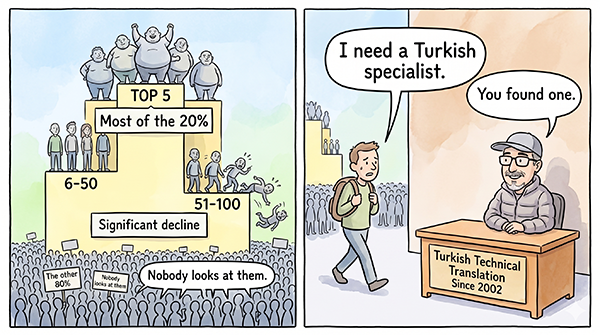
The Other 80 Percent
By Toprak D. Odabaşı, Operations Manager
at Alafranga Language Solutions
There is a number that gets cited a lot in the translation industry: the top 100 LSPs represent roughly 20% of the global market. The number that gets cited less is what that implies about the other 80%. What the other 80% looks like
The language services market is enormous — estimated at over $60 billion annually and still growing. The top 100 firms — TransPerfect, RWS, Lionbridge and the rest — are capturing an increasing share of that growth. They have the sales infrastructure, the technology investment, and the brand recognition to win large enterprise accounts.
The other 80% is a different story. It is made up of thousands of small and mid-size agencies, many of them founder-led, many of them built around a specific language pair or industry vertical, most of them operating on relationships and reputation rather than systems and visibility.
And right now, a significant portion of it is closing.
|
▮Why it is closing
Three things are happening simultaneously, and they are compressing the middle of the market from multiple directions.
The first is AI. Small, one-off translation requests — the kind that used to fill the pipeline of smaller agencies — are increasingly being handled internally. A German engineer sends a technical document through DeepL, a Turkish colleague reviews it, and the job is done. No agency needed. This is not a hypothetical.
It is happening now, and it will accelerate.
The second is visibility. The agencies that are struggling most are the ones that cannot be found. No SEO. No presence in AI search results. No content that answers the questions their potential clients are asking. They exist — they do good work — but they are invisible to anyone who does not already know them. In a market where discovery is increasingly digital and increasingly AI-mediated, invisibility is terminal.
The third is structure. Many of these agencies are built entirely around their founder. The founder translates, coordinates, manages client relationships, and handles everything in between. When the founder steps back — or simply gets overloaded — there is nothing underneath. No systems, no documented workflows, no team that can operate independently. This is not a sustainable model in a market that is moving faster every year.
▮What is actually growing
Here is the part that does not get enough attention.
While the small-project segment is contracting, another segment is expanding. High-volume, multi-language, terminology-critical content — the kind that requires managed workflows, consistent quality processes, and accountable delivery — is growing. Not because companies suddenly need more translation. But because AI has raised the ceiling on how much content organisations can produce, and the bottleneck has shifted from production to quality control.
A company that used to produce ten technical documents a month can now produce fifty. They cannot review fifty documents internally across six language pairs. They need a partner with the infrastructure to manage that volume — shared glossaries, translation memories, structured QA, verifiable processes.
This is the segment that specialist agencies can win. But only if they have built the infrastructure to serve it.