Localization Services
Content that has to work inside an interface, not just read well on a page.
Translation moves the words. Localization deals with everything the words are sitting in: a button that was sized for English, a string that arrives without the sentence around it, a subtitle that has to be read before the shot changes, a page whose meta description should reflect what people search in the target market rather than what the English original said. Turkish makes each of these harder than the source language did. We handle website, software, game and media localization as separate disciplines, because they fail in different ways. |

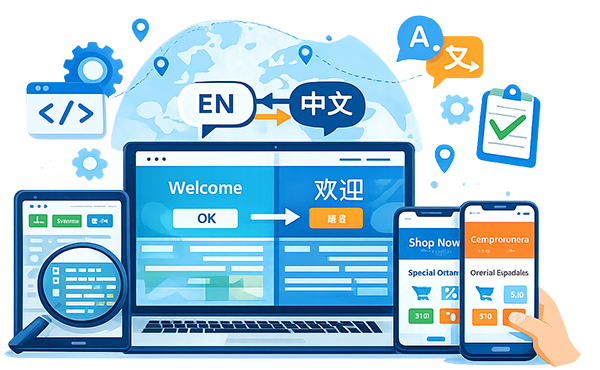
▮Web localization services
Websites are dynamic, responsive, and metadata-driven. Localization here goes beyond translating visible text and it affects SEO performance, compliance visibility, CMS architecture, and conversion behavior across every market you operate in. Our web localization workflow integrates directly with your CMS and live interface constraints, ensuring every language version is as functional and optimized as the source.
From metadata SEO to CTA alignment, we catch what automated tools miss.
App localization operates within strict UI limitations, string logic, and release-cycle dependencies. A single misplaced string can affect build stability, break user flows, or trigger platform compliance issues across every language version simultaneously.
Our software localization workflow is built around your development environment. We handle string extraction, in-context review, pluralization logic, and linguistic validation before release, not after.
Our software localization workflow is built around your development environment. We handle string extraction, in-context review, pluralization logic, and linguistic validation before release, not after.
From string logic to App Store metadata, we validate before release, not after.
▮Game Localization Services
Game content combines the constraints of software with the demands of narrative. Interface strings sit inside hard character limits that differ between mobile and desktop. Dialogue has to keep voice and register consistent across hundreds of files and across every update that follows.
What we handle: interface and menu strings, dialogue and narrative text, item, skill and achievement descriptions, tutorial and onboarding copy, store listings and marketing text, and LiveOps content on a recurring release cycle.
Terminology is locked in a glossary at the start and carried through every update, so a weapon named in the first release is not renamed in the third. We have delivered game localization for studios including HI-REZ Studios and Playata, with Turkish as the core pair.
Learn more about game localization →
Learn more about game localization →
Accurate subtitling requires both linguistic precision and technical synchronization.
We support:
We support:
- Subtitle translation and adaptation
- Time-coded synchronization
- Platform-specific formatting
- SDH (Subtitles for the Deaf and Hard of Hearing)
- Multilingual version management
- Consistency across episodes and seasons ensures brand continuity.
Learn more about media localization→
▮ Why Turkish Is the Hard One
Most agencies quote Turkish at the same rate as any other language. It does not behave like one.
Turkish is agglutinative. A single word carries what English needs a phrase for, which means interface strings run roughly 40 to 50 percent longer than the English source. "Save Changes" becomes "Değişiklikleri Kaydet". Longer labels can expand further. Fixed-width buttons and mobile menus break before anyone notices the text is correct.
Turkish also has four forms of the letter i: İ, i, I and ı. Uppercase and lowercase conversion in application logic gives wrong results unless the locale is set correctly, and search, sorting and login fields are where this surfaces. Dates run DD.MM.YYYY, the decimal separator is a comma, and the currency symbol sits after the figure.
None of this is caught by a translation editor. It is caught by someone who has seen it break before. Turkish has been our founding pair since 2002.
▮How a Localization Project Runs
Briefing and asset preparation. Glossaries, style guides, translation memories, string files, screenshots and interface references collected before anyone starts translating.
Localization. By a linguist with experience in your content type, working in your preferred CAT or TMS environment, inside your string and interface constraints.
In-context review. A second linguist checks the content in the running interface, not only in the editor: accuracy, terminology, fit inside the component, and whether it reads like something written for that market.
Quality assurance. Automated checks for interface overflow, placeholder integrity, concatenation, formatting tags, numbers and omissions.
Delivery and feedback. Returned in your file format, with translation memories and glossaries updated for the next release.
▮ Ways We Can Run It
Human translation. Translated and independently reviewed by two human specialists, with no machine drafting at any stage. Used for regulated content, legal and privacy text, and anything that contractually cannot be sent to a third-party AI provider. Delivered under our ISO 17100:2015 certified quality management system.
AI draft with human review. An AI draft is generated inside memoQ or SDL Trados with your translation memory and glossary applied, then reviewed by a human specialist. Faster and cheaper for content that suits it. Conformity to ISO 17100 is not claimed for machine-drafted text.
AI draft with two review stages. The same drafting step followed by a second independent review, for content where the risk of a single reviewer missing something is not acceptable.
We run a feasibility test before applying AI drafting to any content type. Interface strings, marketing copy and narrative dialogue often fail that test. Help content and documentation usually pass it. We will tell you which before you commit.
Compare workflows