|
Why Translating from English into Turkish Is Harder Than Most Briefs Assume
By Deniz Toprak Odabaşı, Operations Manager at Alafranga Language Solutions
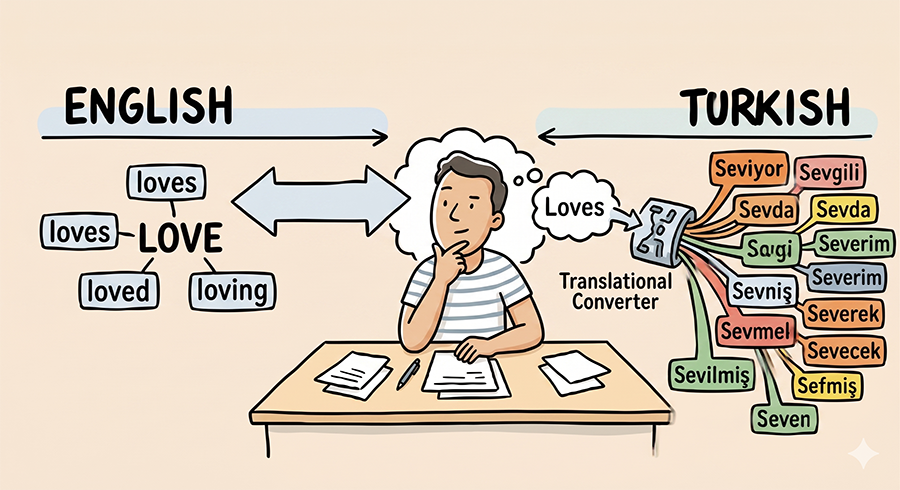  When people hand over an English-to-Turkish project, there's usually a model in their heads. Text goes in English, equivalents are found, Turkish comes out. Words map to words. The job is mechanical. That model is wrong, and it's wrong for a structural reason.
|
English is Indo-European, Turkish is Turkic, and they are built on opposite structural principles. They don't share a grammar logic.
|
You can't know what happened until the sentence ends
English is SVO: subject, verb, object. The action comes right after the actor. Turkish is SOV: subject, object, verb, with the verb sitting at the very end. This sounds like a minor inconvenience but it isn't. In a technical document with long, embedded English sentences, a translator has to read the entire sentence first, hold the meaning in working memory, dismantle the structure, and rebuild it in reverse for Turkish. That cycle repeats with every sentence.
|
A large portion of bad translations are produced at exactly this point. The translator moves through the sentence segment by segment, preserving English order, and produces something that looks Turkish but reads like a transcript. The client says something feels off but can't name what. What happened is that Turkish words ended up sitting on an English skeleton.
Nine English Words Might Become Only One in Turkish
|
English Words Might Become Only One in Turkish
English is an analytic language that uses separate words, prepositions, auxiliary verbs, pronouns, to establish grammatical relationships. Turkish is agglutinative, and most of those relationships get expressed by stacking suffixes onto a single root. "If we are not going to be able to come" is nine words in English. In Turkish, the same meaning can be carried by one: Gelemeyeceksek. One word, with suffixes encoding the condition, the negation, the future tense, and the plural subject.
|
The translator has to produce those suffixes in the right order, carrying the right meaning, and automated systems regularly fail here. A suffix gets dropped, the order shifts, the meaning changes. In a safety instruction or a contract clause, that kind of error has a real cost.
|
The modifier always comes first
In English, a relative clause follows the noun it describes: "The report that was submitted last week." In Turkish it's reversed, with the modifier coming first and the noun landing at the end.
|
Rendered naturally: "Geçen hafta gönderilen rapor." One relative clause is manageable, but a long English sentence with multiple nested clauses requires the translator to invert the entire structure. Less experienced translators either preserve the English order and break the Turkish, or lose the meaning trying to reorganize it. The result ends up in revision, which is where the actual project cost starts climbing.
|
"To break a leg" doesn't translate
This doesn't require a translation expert to say, but in practice far too many texts enter the process as though it weren't true. "To pull someone's leg," rendered literally into Turkish, means nothing. Idioms carry cultural weight, and the translator has to find a Turkish equivalent with comparable cultural baggage. Sometimes one exists and sometimes it doesn't, and when it doesn't, a decision has to be made: preserve the meaning and lose the idiom, or preserve the idiom and risk the meaning. That call has to be traceable and defensible, especially in legal or institutional texts.
|
A separate problem: English "you" addresses everyone, while Turkish distinguishes between sen (informal) and siz (formal or plural). You have to choose one. Writing to a customer, a general audience, a supervisor? That choice changes the tone of the entire document, and if the brief doesn't specify, which most briefs don't, the translator makes a judgment call.
Turkish has no standalone "to be"
|
Turkish has no standalone "to be"
In Turkish, the present-tense copula doesn't exist as a separate verb. What English handles with "is," "am," and "are," Turkish handles through personal suffixes or the particle dır/dir, which on the surface looks like a small difference but in practice means the translator is solving the same structural problem on nearly every sentence.
|
There's one case where Turkish has the structural advantage: pronouns. English tracks gender through "he," "she," and "it," while Turkish uses a single gender-neutral third-person pronoun, o. But this creates its own problem in translation. A source text where gender carries narrative or legal significance loses that information in Turkish unless the translator adds explicit phrasing to preserve it, which means additional judgment, additional words, and additional time.
|
Word-for-word is not a method
A successful English-to-Turkish translation is not a substitution exercise but a rebuild, and the measure of success isn't whether each English word found a Turkish equivalent.
|
It's whether the Turkish text reads as if it was originally thought and written in Turkish. In technical documentation, this distinction is operational rather than aesthetic. A user manual gets used and instructions get followed, and a text built on English scaffolding doesn't hold up under those conditions. Revision requests come in, the deadline moves, a second pass gets added to the project.
Knowing what the language pair actually requires, before the project starts, prevents most of that. If the brief doesn't address it, it's worth asking at the outset.
Further readings:
Further readings:
How to Choose a Turkish Translation Partner for Technical Documentation
Turkish Legal Translation Services
Turkish Legal Translation Services