|
Why Turkish Contract Law Requires More Than a Good Translator
By Volkan Güvenç, Founder — Alafranga Language Solutions
 Most European companies working with Turkish counterparties assume that commissioning a Turkish legal translation is the same as commissioning any other translation. Send the document, receive the translation, proceed. The assumption is understandable. It is also wrong often enough to matter.
|
Turkish law is not a regional variant of a familiar European system. It has its own foundations, its own procedural requirements, and — critically — its own vocabulary, where the same English term may have two valid Turkish translations that carry different legal weight depending on the context.
I have been handling Turkish legal translation since 2002, for European law firms, for LSPs managing multilingual caseloads, and for companies entering the Turkish market. These are the things I find most project managers don't know before they commission their first Turkish legal translation.
|
Turkish law grew from European foundations — but diverged significantly
Turkey's civil law framework was adopted from the Swiss Civil Code in 1926, and commercial law drew substantially from the German Commercial Code. For European legal teams, this is reassuring — the structural logic of Turkish contract law is recognisable.
|
What is less visible is how far domestic legislation, Constitutional Court rulings, and regulatory practice have moved Turkish law away from those foundations over the course of a century. The Turkish Code of Obligations, last substantially revised in 2011, contains provisions and interpretive conventions that have no direct parallel in Swiss or German law. The same is true of Turkish commercial law, which has been shaped by decades of domestic case law and regulatory intervention that is not immediately accessible to a European practitioner reading a translated document.
The practical consequence for translation is this: a translator who knows Turkish and knows legal language is not the same as a translator who knows Turkish law. In a contract dispute, the difference can determine whether a translated document reads as intended to a Turkish court or arbitral tribunal.
|
The terminology problem is specific and predictable
Turkish legal translation produces recurring terminology problems that experienced translators know to anticipate. For project managers working with Turkish legal content for the first time, these are worth understanding in advance.
|
Obligation and liability terms. Turkish law draws a clear distinction between borç (a debt or obligation in the narrow sense), yükümlülük (a duty or obligation in the broader sense), and sorumluluk (liability or responsibility). In English, "obligation" and "liability" are sometimes used interchangeably in commercial drafting. In Turkish legal text, using the wrong term shifts the legal relationship. A contract clause translated with sorumluluk where yükümlülük was intended may change who bears the burden of proof in a dispute.
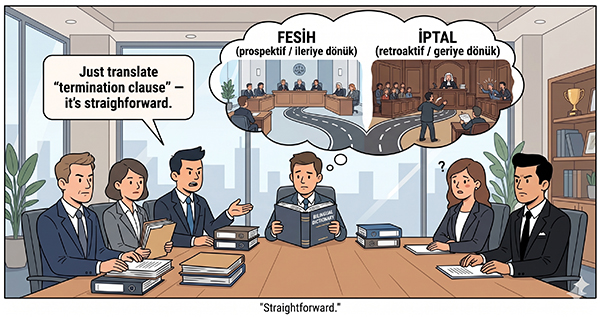
Termination and withdrawal. Turkish contract law treats fesih (termination of a continuing contract, taking effect prospectively) and iptal (cancellation or rescission, potentially with retroactive effect) as distinct concepts with different legal consequences. English-language contracts often use "termination" to cover both. A translator who renders both as fesih produces a document that is technically accurate but legally imprecise — and that imprecision can be exploited in litigation.
Penalty clauses. The Turkish term cezai şart corresponds to what common law systems call a liquidated damages clause or penalty clause. Turkish courts apply the provisions of the Code of Obligations on cezai şart in ways that may surprise common law practitioners — including judicial power to reduce disproportionate penalties. A translation that imports English penalty clause language without adaptation may produce a clause that functions differently under Turkish law than the parties intended.
Force majeure. Turkish law has a developed body of case law on mücbir sebep (force majeure) and beklenmeyen hal (unforeseen circumstances), with the latter corresponding roughly to the doctrine of clausula rebus sic stantibus in civil law systems. These are not interchangeable. A translator who uses them interchangeably produces a document where the allocation of risk in extreme circumstances is unclear.
|
The sworn translation requirement is not administrative — it has legal significance
For documents submitted to Turkish courts, notaries, and most regulatory bodies, translation must be performed or certified by a sworn translator (yeminli tercüman) — a translator who has passed a specific examination and is registered with the relevant court. The sworn translator's signature and seal make the translation an official document for legal purposes.
|
This requirement is often treated as a formality — a stamp to be obtained after the translation is complete. It is more significant than that.
First, the sworn translator takes legal responsibility for the accuracy of the translation. This changes the accountability structure of the process and affects how translators approach their work.
Second, many Turkish institutions have specific format requirements for sworn translations — not just the content, but the physical or digital form of the certified document, the placement of the seal, and the wording of the certification statement. Format errors cause rejections, and rejections create delays that are often not recoverable within the original matter timeline.
Third, the sworn translation requirement applies differently to different document types and different institutions. Court submissions, notarial acts, trade registry filings, regulatory applications, and apostilled documents each have their own requirements, and these have been updated at various points as Turkish institutions have moved toward digital processes. What applied two years ago may not apply today.
|
Regulatory bodies have their own terminology conventions
European companies working in regulated sectors in Turkey — energy, financial services, pharmaceuticals, data protection — encounter a further layer of complexity: each regulator maintains its own terminology conventions, and documents submitted to those regulators are expected to use the terms those regulators use, not general legal Turkish.
|
BDDK (the Banking Regulation and Supervision Agency), SPK (the Capital Markets Board), EPDK (the Energy Market Regulatory Authority), and the Turkish Competition Authority each publish guidance, communiqués, and secondary legislation in a specific register. A compliance document translated by a generalist legal translator who has not worked with the relevant regulator's output may be technically accurate and still be flagged as non-conforming.
This is particularly relevant for GDPR-related documentation submitted to Turkish data protection authorities under the Personal Data Protection Law (KVKK), where the Turkish regulatory framework developed its own terminology in parallel with European frameworks, and the two do not always map onto each other cleanly.
|
Cross-border arbitration adds a further dimension
Turkey is a signatory to the New York Convention on the Recognition and Enforcement of Foreign Arbitral Awards, and Turkish entities are regularly parties in ICC, LCIA, and ICSID proceedings. For legal teams managing arbitration matters with a Turkish dimension, translation quality in the evidentiary record matters — not just for comprehension, but because poorly translated documents can be challenged by opposing counsel and may require re-translation at cost and delay.
|
Turkish court decisions and arbitral awards produced in Turkey follow strict formal conventions. The structure of a court decision — the introductory section (ön bilgiler), the reasoning section (gerekçe), and the operative part (hüküm) — carries legal significance, and translators who are not familiar with Turkish court formatting conventions sometimes flatten this structure in ways that make the translated document harder to use in international proceedings.
|
What this means for how translation should be commissioned
None of the above makes Turkish legal translation unusually difficult — it makes it specific. A translator with genuine Turkish legal knowledge navigates these issues as a matter of course. The problems arise when Turkish legal translation is treated as a commodity, assigned to a generalist, or reviewed by someone without Turkish legal background.
|
Some practical questions worth asking your translation partner before commissioning Turkish legal work:
Does the translator have specific Turkish legal experience, or legal language experience in general? For high-stakes content, these are not the same thing. Is AI translation used on legal documents? If so, under what conditions, and is the client informed? What is the review process — is a second Turkish-qualified specialist involved, or is review performed by the project manager? Can the agency obtain sworn translator certification where required, and do they understand the format requirements of the specific institution the document is being submitted to? Has the agency worked with documents going to Turkish regulatory bodies — and if so, which ones?
We have been handling Turkish legal translation since 2002 — contracts, arbitration documents, regulatory submissions, company formation documents, and compliance materials across BDDK, SPK, EPDK, and KVKK frameworks. If you are working on a matter with a Turkish legal dimension and want to discuss the specifics, we are happy to do that before you commission the work.
Why Turkish Is Not Just Another European Language for Technical Translation
When Terminology Inconsistency Becomes a Real-World Problem
Why Turkish Legal Translation Demands Ongoing Legal Literacy
How to Choose a Turkish Translation Partner for Technical Documentation
Turkish Legal Translation Services
Further readings:
Why Translating from English into Turkish Is Harder Than Most Briefs AssumeWhy Turkish Is Not Just Another European Language for Technical Translation
When Terminology Inconsistency Becomes a Real-World Problem
Why Turkish Legal Translation Demands Ongoing Legal Literacy
How to Choose a Turkish Translation Partner for Technical Documentation
Turkish Legal Translation Services