KI-gestützte Übersetzung mit menschlicher PrüfungDen ersten Entwurf liefert die Maschine. Jede Entscheidung danach trifft ein Fachübersetzer.
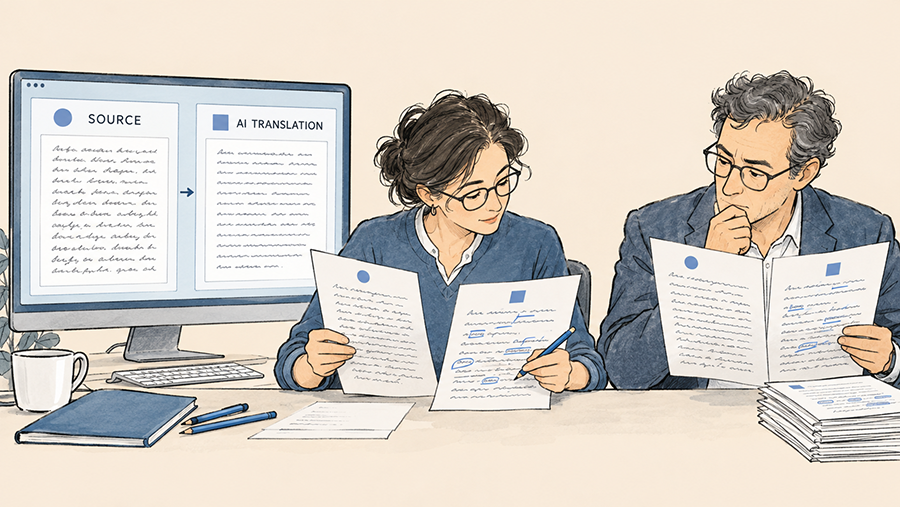
SmartEdit und SmartEdit Pro sind unsere KI-gestützten Workflows. Eine Übersetzungsengine (DeepL, GPT oder Claude, gewählt nach Sprachpaar und Textsorte) erstellt den ersten Entwurf direkt in memoQ oder Trados, auf Grundlage Ihres Translation Memorys und Ihrer freigegebenen Terminologie. Ab diesem Punkt übernehmen qualifizierte Fachübersetzer. Weitere Prüfschritte lassen sich bei Bedarf ergänzen; in der Regel empfehlen wir eine von zwei Varianten:
KI-Entwurf + Post-Editing
Auf den maschinellen Entwurf folgt ein vollständiges Post-Editing durch einen qualifizierten Fachübersetzer, der jedes Segment mit dem Ausgangstext, der Terminologie und Ihren Stilvorgaben abgleicht. Das ist unser Workflow SmartEdit.
KI-Entwurf + Post-Editing + Revision + Endkontrolle
Maschineller Entwurf, vollständiges Post-Editing, Revision durch eine zweite Fachperson und eine abschließende Qualitätskontrolle vor der Freigabe. Das ist unser Workflow SmartEdit Pro.
|

▮Wo der KI-Entwurf im Türkischen an seine Grenzen stößt
- Fehlendes Subjekt
Im Türkischen darf das Subjekt entfallen. KI-Entwürfe lassen es häufig auch dort weg, wo der Ausgangstext eine handelnde Person nennt. Dann ist unklar, wer einen Arbeitsschritt ausführen soll. In Sicherheits- und Wartungsanleitungen ist das keine Stilfrage. - Schachtelsätze, die nicht aufgelöst werden
Deutsche Fachtexte arbeiten mit langen Satzgefügen und eingeschobenen Relativsätzen. Das Türkische ist agglutinierend und baut Sätze von hinten auf. Übernimmt der Entwurf die deutsche Struktur, muss der Leser den Satz rückwärts entschlüsseln. Falsch ist der Satz nicht, aber unbrauchbar. Er muss aufgeteilt werden. - Terminologie zwischen TSE und EU-Quellen
Viele Fachbegriffe haben in den Normen des Türkischen Normungsinstituts (TSE) eine andere Form als in Dokumenten, die aus dem EU-Recht übernommen wurden. Die KI wählt die im Netz häufigere Variante. Welche richtig ist, hängt davon ab, wo Ihr Dokument eingesetzt wird. Das ist eine fachliche Entscheidung, kein Nachschlagen. - Wechsel zwischen „Sie“ und „du“
Das Türkische unterscheidet wie das Deutsche zwischen förmlicher und vertrauter Anrede. KI-Entwürfe wechseln innerhalb eines Dokuments zwischen beiden, besonders in Benutzeroberflächen und Bedienungsanleitungen. - Deutsche Komposita
Zusammengesetzte Begriffe wie „Druckbegrenzungsventil“ werden Bestandteil für Bestandteil übersetzt, statt in den eingeführten türkischen Fachbegriff überführt zu werden.
▮So läuft SmartEdit ab
- Vorbereitung. Glossar, Translation Memory und Referenzmaterial werden eingerichtet, bevor ein einziges Segment erzeugt wird.
- KI-Entwurf. Erstellt in memoQ oder Trados über eine API-Anbindung, nicht in einem separaten Tool, mit Ihrem TM und Glossar ab dem ersten Segment.
- Post-Editing. Jedes Segment wird von einem Fachübersetzer aus Ihrem Fachgebiet gelesen und korrigiert.
- Automatisierte Qualitätssicherung. Tags, Platzhalter, Zahlen, Einheiten und Formatierung werden geprüft.
- Lieferung. Sie erhalten die Dateien im gewohnten Format, dazu das aktualisierte TM und Glossar für Ihr nächstes Projekt.
▮Erst prüfen, dann empfehlen
Was wir am häufigsten anbieten
| Leistung | SmartEdit | SmartEdit Pro |
| Eignungsprüfung anhand Ihrer Inhalte | ● | ● |
| Briefing, Einrichtung von TM und Terminologie | ● | ● |
| KI-Entwurf in memoQ oder Trados mit Ihrem TM und Glossar | ● | ● |
| Vollständiges Post-Editing durch einen Fachübersetzer | ● | ● |
| Eigenkontrolle durch den Post-Editor | ● | ● |
| Automatisierte Qualitätssicherung | ● | ● |
| Revision durch eine zweite Fachperson | ● | |
| Abschließende Qualitätskontrolle vor Freigabe | ● | |
| Fachliche Prüfung | auf Anfrage | auf Anfrage |
| Korrekturlesen vor Veröffentlichung | auf Anfrage | auf Anfrage |
| Aktualisiertes TM und Glossar | ● | ● |
▮Was Kunden vor jedem Projekt fragen
Werden meine Inhalte zum Training von KI-Modellen verwendet?
Nein. Die Entwürfe entstehen über kostenpflichtige API-Zugänge, deren Bedingungen eine Nutzung Ihrer Inhalte zum Modelltraining ausschließen. Ihre Texte landen nie in öffentlichen Chat-Tools. Wenn Ihr Vertrag oder Ihre Geheimhaltungsvereinbarung keine KI-Verarbeitung durch Dritte zulässt, sagen Sie uns Bescheid. Wir bieten dann die reine Humanübersetzung an.
Erfahre ich, ob KI eingesetzt wurde?
Ja. Der Workflow steht im Angebot, in der Auftragsbestätigung und im Lieferschein. KI-gestützte Übersetzungen geben wir nie als Humanübersetzung aus.
Wie viel günstiger ist SmartEdit als eine Humanübersetzung?
Das hängt von der Datei ab. Deshalb kalkulieren wir nach der Eignungsprüfung und nicht nach einer festen Rabattstaffel. Am meisten sparen gut strukturierte Fachtexte mit einem gepflegten Translation Memory. Schwache Ausgangstexte, ungeklärte Terminologie oder ein schwieriges Sprachpaar können die Ersparnis aufzehren. Dann empfehlen wir HumanExpert.
Ist SmartEdit konform mit ISO 17100?
Nein. ISO 17100 regelt die Humanübersetzung, und für maschinell vorübersetzte Texte beanspruchen wir keine Konformität. Beide SmartEdit-Workflows laufen in unserem an ISO 17100:2015 ausgerichteten Qualitätsmanagementsystem. Verlangt Ihr Einkauf Konformität mit ISO 17100, ist HumanExpert Pro der richtige Workflow.
Kann ich eine KI-Engine auswählen oder ausschließen?
Ja. Normalerweise wählen wir die Engine nach Sprachpaar und Textsorte. Gibt Ihr Unternehmen bestimmte Anbieter vor oder schließt sie aus, halten wir uns daran.
Können Sie bereits vorhandene KI-Übersetzungen nachbearbeiten?
Ja, nach derselben Eignungsprüfung. Wir sehen uns zuerst eine Stichprobe an, denn Übersetzungen, die ohne Ihr Translation Memory und Glossar entstanden sind, brauchen oft mehr Nacharbeit als ein neuer Entwurf in memoQ oder Trados. Mehr erfahren
Funktioniert SmartEdit auch für andere Sprachen als Türkisch?
Ja, in allen unseren über 40 Sprachen. Die Qualität der Entwürfe schwankt je nach Sprachpaar, deshalb ist die Eignungsprüfung bei manchen Sprachpaaren wichtiger als bei anderen.
Wir haben kein Translation Memory und kein Glossar. Geht SmartEdit trotzdem?
Ja. Wir extrahieren die wichtigsten Fachbegriffe aus Ihren Inhalten und stimmen sie mit Ihnen ab, bevor der Entwurf entsteht. Das erste Projekt braucht mehr Post-Editing als die folgenden; jede Lieferung erweitert Ihr Translation Memory und Glossar.
Wem gehört das Translation Memory?
Ihnen. Translation Memory und Glossar aus Ihren Projekten erhalten Sie mit jeder Lieferung zurück und können sie zu jedem anderen Dienstleister mitnehmen.