The EU Machinery Regulation 2023/1230: What Changes for Your Documentation in January 2027On 20 January 2027, the Machinery Directive 2006/42/EC will stop to be applied. From that date, machinery placed on the EU market will have to conform to Regulation (EU) 2023/1230, the Machinery Regulation. There will be no overlap period. A machine placed on the market on 19 January 2027 is to carry a declaration of conformity referencing the Directive. The same machine placed on the market one day after will have to carry a declaration referencing the Regulation, supported by a technical file prepared under the stated Regulation.
By Vedat Güven, terminology consultant at Alafranga Language Solutions, specialising in regulatory and technical documentation between EU languages and Turkish. For the Turkish side of CE documentation, see Compliance in Turkish.
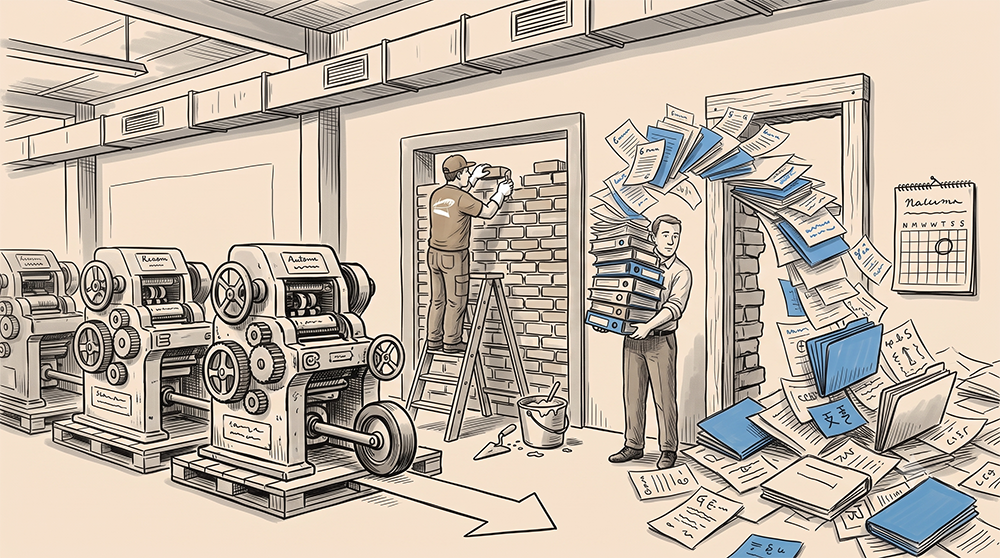 |
For engineering and compliance teams, this is a familiar type of deadline. For documentation teams, it is something else: a fixed date by which a substantial part of the documentation set for every machinery product sold in the EU must be revised, and, for every export market, retranslated.
I want to walk through what actually changed in the documentation, because the honest starting point is that most parts of the regulation did not change, and knowing where the changes fall is what separates a controlled revision from a panicked one.
Most of It Carries Over. That Is Not the Same as Nothing ChangesRoughly ninety percent of the requirements in the new Regulation correspond to the previous edition of the Machinery Directive. The essential health and safety requirements structure survives. The CE marking logic survives. Harmonised standards remain the practical route to presumption of conformity.
|
What this means for documentation: Your existing manuals are not obsolete. Every one of them, however, has to be touched. Every document that cites the legal framework of the previous version will be citing the wrong one after 20 January 2027. The declaration of conformity references the Directive by name and number. Many instruction manuals reference it in their safety chapters. Technical files are organised around its annex structure. None of these references survive the transition, and reference corrections are never only reference corrections; they cascade into the surrounding text.
The Declaration of Conformity: Small Document, Zero ToleranceThe EU declaration of conformity is the shortest document in the technical file and the one with the least tolerance for error. Under the Regulation, the declaration must reference Regulation (EU) 2023/1230, follow the updated content requirements, and use the terminology the Regulation establishes.
|
I wrote previously about how declarations translated into Turkish fail not because the translation is incorrect but because the wording does not match the expected regulatory formula. The same failure mode now applies inside the EU, in every language, during the transition. A declaration that mixes Directive-era formulas with Regulation-era references will read fluently and fail formally. Whoever revises these documents needs to know both of the frameworks, and whoever translates them needs source text that has been revised first. Translating the old declaration into twenty languages in 2026 is work you will pay for twice.
Digital Instructions: The Genuinely New PartThe Regulation permits manufacturers, for the first time, to supply instructions for use in digital format. For machinery intended for non-professional users, safety information must still be provided on paper, and any buyer retains the right to request a paper copy free of charge at the time of purchase.
|
This is a real structural change, and it is currently the least stable part of the picture. The Omnibus IV proposal, as of February 2026, seeks to make digital declarations of conformity mandatory from January 2027 while excluding the machinery sector from the transition period granted to other industries. A coalition of industry associations including EGMF, FEM and CECE objected publicly in February 2026, arguing this departs from the negotiated text of the Regulation, which allows either paper or digital. The practical advice while this settles: build your documentation process so that it can produce both, because the answer to "paper or digital" may change between now and the deadline, and may differ by product category.
For multilingual documentation, digital delivery changes more than the file format. Digital instructions can be updated after the machine ships, which means translation stops being a one-time event at the end of production and becomes a maintained process across the product life. Version control across languages, which was an internal quality concern under the Directive, becomes a compliance-visible concern under the Regulation. Every language version has to move through the same update cycle, not just the source.
|
New Content: Cybersecurity and Safety Functions with Learning Behaviour
The revised essential health and safety requirements in the Regulation extend into territory the 2006 Directive did not cover: protection against corruption of safety-related software, security of connected machinery, and machinery with self-evolving behaviour, meaning safety functions that rely on learning systems.
|
For documentation teams, each of these produces text that did not previously exist. Risk assessments build up new sections. Instructions gain new warnings and new operating limits. And the terminology for these sections is genuinely unsettled. The harmonised standards that will carry the detailed requirements are still being revised; the complete list under the Regulation is expected only towards the end of 2026, shortly before the deadline. Documentation written in 2026 will therefore be written partly ahead of its standards, and the terminology chosen now, in every language, will either align with those standards or need correction later. This is an argument for terminology discipline, not for waiting.
A second issue follows from this. Documentation held in the cloud keeps moving; the machine already delivered does not. Configuration management therefore has to link each delivered unit to the documentation version that actually describes it.
|
The Annex Reshuffle and Partly Completed Machinery
Two structural points worth flagging for anyone who maintains technical files. The list of high-risk machinery formerly in Annex IV of the Directive now sits in Annex I of the Regulation, with six categories requiring mandatory third-party conformity assessment regardless of harmonised standard use. Cross-references in technical files, quality procedures, and supplier documentation that point to "Annex IV machinery" point to the wrong place after January 2027.
|
The Regulation also sharpens the definition of partly completed machinery and its documentation trail: the declaration of incorporation and assembly instructions. I noted in the earlier article that Turkish regulatory documentation for partly completed machinery already trips up European documentation teams; the Regulation's clarified definitions will flow into Turkey's mirrored legislation in due course, and the terminology in both directions will shift with it. That subject deserves its own article, and it will get one.
The transition has a fixed end and no grace period. Machinery documentation prepared under the Directive cannot be placed on the market after 19 January 2027. The sensible sequence is: revise source documentation against the Regulation now, freeze terminology decisions deliberately, and run the multilingual updates while the deadline is still a date on the calendar rather than a condition of sale.
|
Why 2026 Is the Working Year, Not 2027
Set aside the regulation for a moment and consider the arithmetic. A manufacturer selling machinery in the EU with documentation in, say, fifteen languages is looking at: revision of the source technical file and instructions, revision of the declaration of conformity, new content for cybersecurity and digital delivery where applicable, and then the multilingual pass across all of it. The companies that treat this as a Q4 2026 task will discover that their documentation revision, their standards alignment, and their translation cycle all compete for the same weeks, together with everyone else's.
|
The transition has a fixed end and no grace period. Machinery documentation prepared under the Directive cannot be placed on the market after 19 January 2027. The sensible sequence is: revise source documentation against the Regulation now, freeze terminology decisions deliberately, and run the multilingual updates while the deadline is still a date on the calendar rather than a condition of sale.
The Regulation did not make documentation harder. It made the cost of postponing it visible, and it attached a date to it.
|
Summing Up of the Changes with the New Revision
High-risk machines have been reclassified: The former Annex IV has been divided into two parts—Part A and Part B—in the new Annex I. For the six categories in Section A (removable mechanical power transmission devices and their guards, vehicle service lifts, cartridge-operated portable nailing machines, safety components exhibiting self-adaptive behavior through machine learning, and machines incorporating such embedded systems), the involvement of a notified body is mandatory; In Section B, self-assessment (Module A) remains possible if there is full compliance with harmonized standards.
|
Artificial intelligence and cybersecurity: Self-evolving behavior, protection of control systems against disruption, and human-machine interaction have been included among the essential health and safety requirements (new Annex III).
Digital instructions for use: Instructions may be provided digitally; the right to a free printed copy upon request is preserved.
The concept of “substantial modification”: Anyone making a substantial modification to a machine already on the market assumes the manufacturer’s obligations.
Chain of economic operators: Separately defined obligations for the manufacturer, authorized representative, importer, and distributor (compliance with the New Legal Framework).
Why Translating from English into Turkish Is Harder Than Most Briefs Assume
Why Turkish Is Not Just Another European Language for Technical Translation
When Terminology Inconsistency Becomes a Real-World Problem
Why Turkish Legal Translation Demands Ongoing Legal Literacy
How to Choose a Turkish Translation Partner for Technical Documentation
Turkish Legal Translation Services
How to Get a Legal Turkish-to-English Translation: A Step-by-Step Guide
Turkey Has No National Translator Certification: Here Is What Buyers Should Know
Further readings:
Why Translating from English into Turkish Is Harder Than Most Briefs Assume
Why Turkish Is Not Just Another European Language for Technical Translation
When Terminology Inconsistency Becomes a Real-World Problem
Why Turkish Legal Translation Demands Ongoing Legal Literacy
How to Choose a Turkish Translation Partner for Technical Documentation
Turkish Legal Translation Services
How to Get a Legal Turkish-to-English Translation: A Step-by-Step Guide
Turkey Has No National Translator Certification: Here Is What Buyers Should Know