One Translator or a Team? You Find Out on the Worst Possible DayMost translation relationships work fine for years. One good translator, a known subject area, a predictable flow of documents. There is nothing wrong with this arrangement, and anyone who tells you otherwise is selling something.
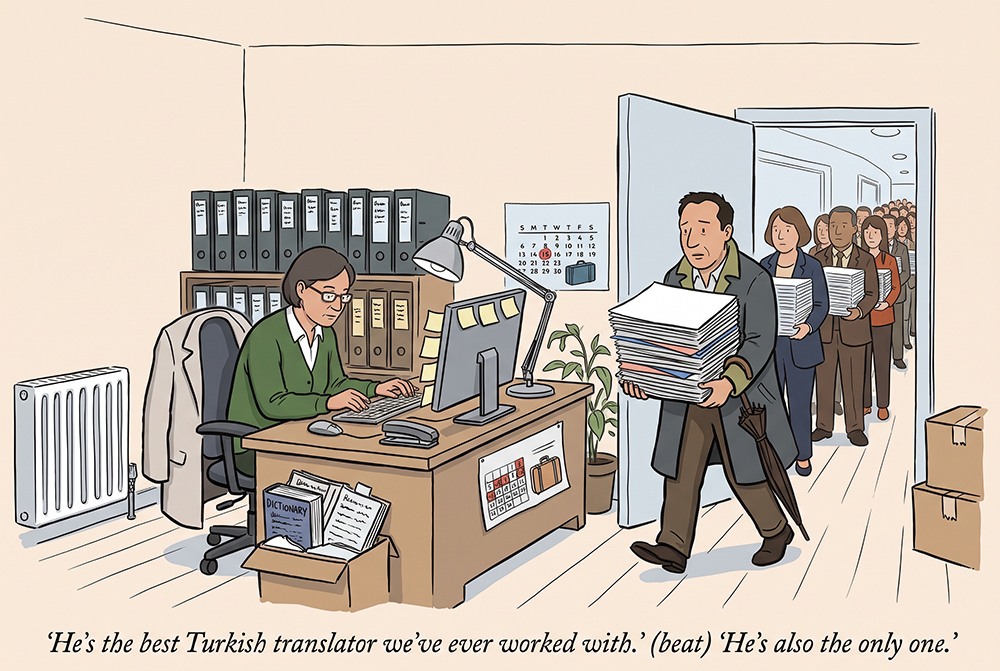
The problem is that the arrangement is never tested on an ordinary day. It gets tested when the volume triples with three days' notice, when the translator is in hospital, when a second language is suddenly required, or when someone asks who performed the revision and you realise nobody did.
By Volkan Güvenç, Director & Founder
 |
At that point you discover what you actually bought. Not a translation service, but a person. And a person is not a redundant structure.
This is not an argument against working with individual translators. It is an argument for knowing which of the two you have, before the day you need the other one.
What single point dependency looks like in practice
None of these are dramatic. They are ordinary Tuesdays that become expensive.
The volume spike. A tender document arrives with a fixed submission date. Forty thousand words in five working days. One translator produces two to two and a half thousand words a day at professional quality. The arithmetic does not resolve. You either miss the deadline or you find three unfamiliar translators in forty-eight hours and hope their terminology agrees.
The absence. Illness, family emergency, a two-week holiday booked six months ago. There is no handover, because there was never anyone to hand over to. The translation memory sits on the translator's laptop.
The second language. Your Turkish is settled. Now the same document set needs Greek, Romanian, and Arabic, and the three files need to say the same thing. Consistency across languages is a coordination problem, and coordination is a role, not a favour.
The revision question. An auditor, a client's legal department, or a certification body asks who revised the translation. ISO 17100 requires a second qualified person comparing source against target. If your translator revised their own work, the answer is that nobody did. This is not a quality opinion. It is a documentable gap.
The exit. The translator retires, changes career, or takes a staff position and stops freelancing. Fifteen years of accumulated terminology decisions leave with them, unless the memory and glossary were maintained somewhere else. Usually they were not.
| Working with one translator | Working with a coordinated team | |
| Capacity ceiling | 2,000 to 2,500 words per day, fixed | Scales by adding linguists against a shared memory |
| Absence cover | None. Work stops | Second linguist briefed on the same memory and glossary |
| Multiple languages | Separate relationships, separate terminology decisions | One coordination point, one terminology base |
| Revision step | Self review, unless separately arranged | Second qualified reviser as standard |
| ISO 17100 revision requirement | Not met by a single person | Met |
| Translation memory ownership | Usually on the translator's machine | Held centrally, maintained, handed over on request |
| Terminology continuity if the person leaves | Lost | Retained |
| Cost per word | Lower | Higher, by the cost of the coordination and revision layers |
| Direct access to the person translating | Immediate | Through a coordinator |
| Best fit | One language pair, one subject area, steady moderate volume, no audit exposure | Multiple languages or subjects, variable volume, regulated or audited documentation |
|
Where the single translator is the better answer
This needs saying plainly, because a comparison that always ends in the same conclusion is not a comparison.
If you work in one language pair, in one subject area, with a steady and moderate flow of documents, and nothing you publish will be read by a regulator or a court, a good individual translator is the better arrangement. Lower cost, faster communication, and a level of consistency that comes from one mind holding the whole context.
|
Our own network is built from individual translators. Around 5,100 records, roughly 2,000 of whom meet our current quality and pricing criteria. We do not think less of that arrangement. We think it stops working at identifiable thresholds, and we think buyers should know where those thresholds are rather than discovering them.
The thresholds are these. More than two language pairs. Content that crosses subject areas inside the same project. Volume that varies by more than roughly double between months. Any documentation that carries audit, certification, or legal exposure. Any situation where a delivery date has a penalty attached to it.
Below those lines, one translator. Above them, structure.
|
If you are a language service company, the exposure is larger
The same question sits differently on your side of the desk.
When a direct client depends on one translator, the consequence lands on the client. When you depend on one Turkish translator, the consequence lands on your client, and the contractual obligation is yours. You explain the delay. You absorb the penalty. You carry the professional indemnity.
|
There is also a quieter version of the same risk that we see more often than the dramatic one. A translator who has been reliable for years quietly becomes the only person who understands a client's terminology. Nothing has gone wrong yet. Nothing needs to. The exposure exists whether or not it is realised, and it is invisible on any report you run.
The useful questions to ask any Turkish subcontractor are the same ones your clients should be asking you.
Who performs the revision, and are they a different qualified person from the translator. Where does the translation memory live, and will it be handed over intact if the relationship ends. What happens to a project mid-flow if the assigned linguist becomes unavailable. Can capacity be added without restarting the terminology from zero. How long does a terminology query take to reach the person actually translating.
A supplier who can answer all five without checking is not necessarily cheaper. They are the reason you do not have to explain anything to your client.
|
How we are structured, and why
We started in Istanbul in 2002 with Turkish at the centre. Every other language we work in was added because a client asked for it, not because it looked good on a list.
Projects have run through ]Project Open[, the project management system we have hosted on our own servers since 2009. Terminology decisions, revision records, and delivery history sit there rather than in anyone's inbox. When a linguist becomes unavailable, the replacement reads the same memory and the same glossary rather than starting an argument that was settled in 2014.
|
Revision is a separate person by default in our HumanExpert and SmartEdit Pro workflows, which is what ISO 17100 requires and what our Bureau Veritas audit examines.
None of this makes us the right choice for every project. It makes us the right choice above the thresholds described earlier. Below them, we will tell you so, and occasionally we do.
Frequently asked questions
Is a freelance translator or a translation agency better?
Neither is better in general. An individual translator is usually the better choice for one language pair, one subject area, steady volume, and no audit exposure. A coordinated team becomes necessary above roughly two language pairs, with variable volume, mixed subject matter, or documentation subject to certification or legal review.
Can a single translator meet ISO 17100?
No. ISO 17100 requires revision by a second qualified person comparing source and target. A translator revising their own work does not satisfy the requirement, regardless of how experienced they are.
How much can one translator produce per day?
Around 2,000 to 2,500 words per day at professional quality for technical or legal content, sustained. Higher figures are achievable in bursts, or with heavy translation memory leverage on repeat content, but not as a planning assumption.
Who owns the translation memory?
It depends entirely on what was agreed. In many individual arrangements it was never agreed, and the memory sits on the translator's machine. Ask before you need it, not after.
What happens if the assigned translator becomes unavailable mid-project?
In a single translator arrangement, the project stops until they return. In a coordinated structure, a second linguist working from the same memory and glossary continues, with the revision step catching any divergence.
Why Translating from English into Turkish Is Harder Than Most Briefs Assume
Why Turkish Is Not Just Another European Language for Technical Translation
When Terminology Inconsistency Becomes a Real-World Problem
Why Turkish Legal Translation Demands Ongoing Legal Literacy
How to Choose a Turkish Translation Partner for Technical Documentation
Turkish Legal Translation Services
How to Get a Legal Turkish-to-English Translation: A Step-by-Step Guide
Turkey Has No National Translator Certification: Here Is What Buyers Should Know
Further readings:
Why Translating from English into Turkish Is Harder Than Most Briefs Assume
Why Turkish Is Not Just Another European Language for Technical Translation
When Terminology Inconsistency Becomes a Real-World Problem
Why Turkish Legal Translation Demands Ongoing Legal Literacy
How to Choose a Turkish Translation Partner for Technical Documentation
Turkish Legal Translation Services
How to Get a Legal Turkish-to-English Translation: A Step-by-Step Guide
Turkey Has No National Translator Certification: Here Is What Buyers Should Know