How to Choose a Turkish Translation CompanyBefore You Choose a Turkish Translation Company, Decide What You Are Buying
|
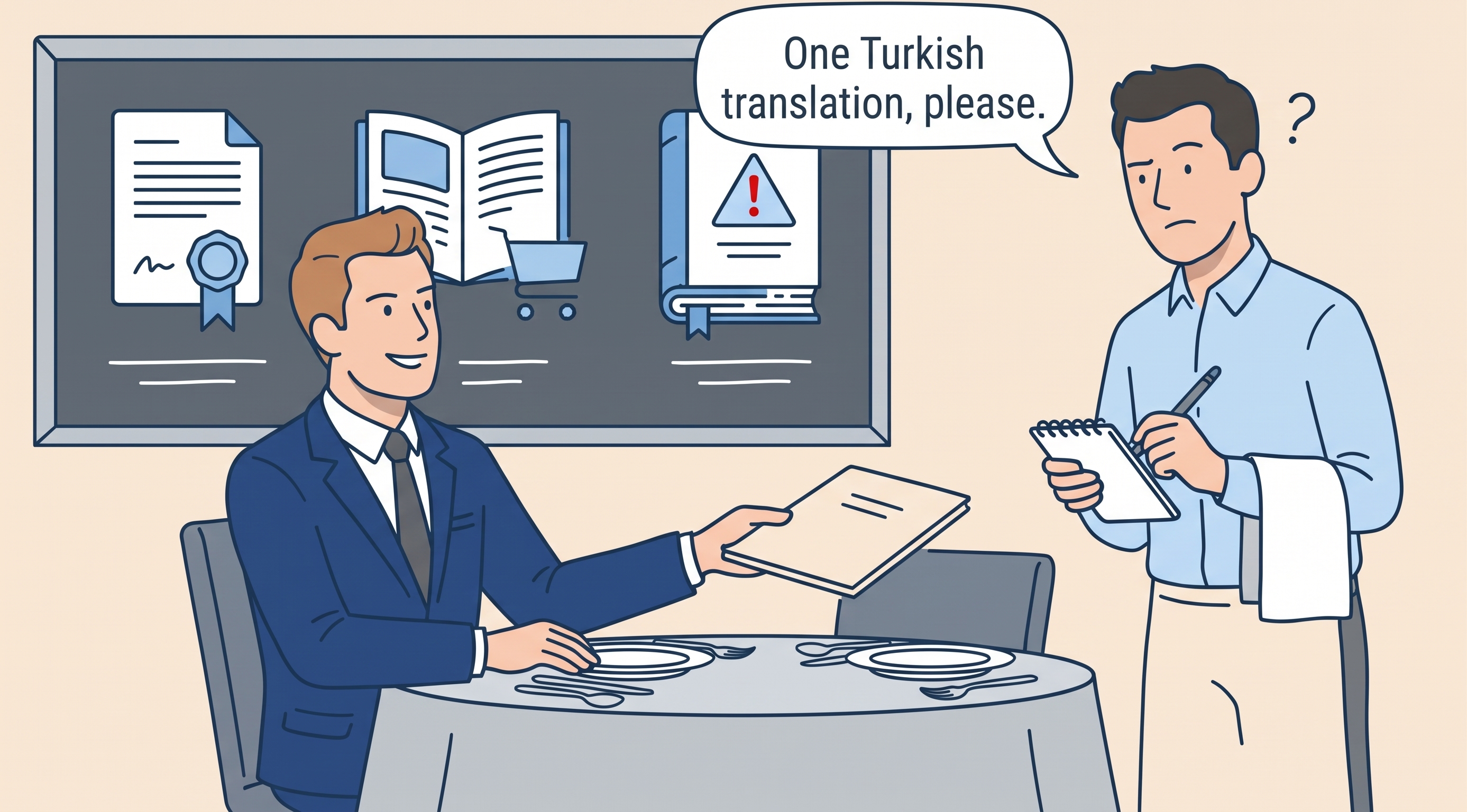
Start with the content, not the supplier.
Three questions decide most of the choice:
- What happens if the translation is wrong? What happens if the translation is wrong? An awkward sentence on an internal page costs nothing. A wrong torque value, a mistranslated contract clause or an incorrect dosage instruction can cost a great deal.
- Who will read it, and where? A Turkish court, a Turkish customer, an EU regulator and your own staff in Turkey have different expectations, and some of them have formal requirements.
- Is this a one-off or a programme? A single document is a purchase. A product that is updated every quarter, in Turkish and four other languages, is an ongoing workflow with its own terminology, memory and review process.
Once these are answered, the type of service usually follows.
- Sworn translation for official use in Turkey Documents submitted to Turkish courts, notaries, land registries or public authorities are usually translated by a sworn translator (yeminli tercüman) registered with a Turkish notary, and the translation is then notarised. Documents going the other way, from Turkey for use abroad, may also need an apostille. A specialist translation without these steps can be rejected, however good the language is.
Choose this when: the document is being filed, registered or presented to an authority. Tell the provider exactly where it will be submitted; they should tell you what form it needs to take. - A freelance translator A good freelance Turkish translator can be the best value for a single language, a steady volume and a subject they know well. Many of the best Turkish linguists work freelance.
Watch for: capacity (one person, one set of working hours), the absence of a second reviewer unless you arrange one, and continuity when they are unavailable. For anything safety-critical or legally binding, a single translator without independent review is a risk regardless of their skill. - A translation agency An agency adds what a single translator cannot: a second linguist who reviews the work, project management, file engineering for formats such as InDesign, FrameMaker or XML, several languages under one contract, and continuity when people change. It also means someone is accountable for the result.
Watch for: agencies that resell work without checking it. Ask who will translate, who will review, and whether those people have worked in your subject before. - AI translation, with or without human review AI translation is now good enough for internal documents, first drafts and high-volume, low-risk content such as product descriptions. Raw AI output still makes errors that a non-Turkish speaker cannot see: wrong terminology, numbers changed, negations reversed, and text that is grammatical but reads as foreign to a Turkish customer.,,
The middle path is AI-assisted translation, where an AI draft is produced with your glossary and translation memory applied, and a qualified human reviews it before delivery. For regulated content such as medical device labelling, contracts and safety instructions, a fully human workflow is still the safer default.
Choose this when: volume is high, the risk is low, and you can say clearly which content is allowed to go through AI.
The four options side by side:
| Best for | Second reviewer | Main risk | Relative cost | |
| Sworn translation | Documents for Turkish courts, notaries and authorities | Not by default | Rejected if the form is wrong | Per page, plus notary fees |
| Freelance translator | One language, steady volume, a familiar subject | Only if you arrange one | Capacity and continuity | Often the best value for a single language |
| Translation agency | Several languages, complex files, ongoing programmes | Usually built in | Work resold without being checked | Higher; includes review and project management |
| AI with human review | High-volume, low-risk content | One qualified reviewer per language | Errors a non-Turkish speaker cannot see | Lowest for large volumes; the review is still paid work |
A quick way to place your own content:
| Content | Examples | What it usually needs |
| Official documents for use in Turkey | Court filings, powers of attorney, company documents, certificates | Sworn translation, notarised, with an apostille where required |
| Safety-critical and regulated content | Safety instructions, medical device labelling, instructions for use | Fully human translation with independent review |
| Technical documentation | Manuals without safety-critical sections, datasheets, specifications | Specialist translation, or an AI draft with two human reviewers |
| Marketing and web content | Websites, campaigns, brand pages | Human translation adapted for Turkish readers |
| High-volume, low-risk content | Product descriptions, knowledge base articles, internal documents | AI draft with one qualified human review |
What makes Turkish different
- Word structure. Turkish builds meaning by adding suffixes, so one Turkish word can carry what English says in a phrase. Terminology that is not managed carefully drifts quickly across a document set.
- Text length. Turkish text often runs longer than the English source. In software interfaces, labels and printed layouts, that means truncated strings or reflowed pages unless the provider checks the result in context.
- Characters. Turkish has a dotted and a dotless i (İ/i and I/ı), and standard case conversion in software gets them wrong. Fonts, file encodings and search functions all need to handle ş, ğ, ç, ö, ü and ı correctly.
- Standards terminology. Turkish technical standards (TSE) and regulators use their own terms, which do not always map directly to EN or ISO wording.
- Subject: technical, legal and medical content costs more because the translators are scarcer
- Workflow: translation only, translation plus independent review, or AI draft plus review
- Repetition: content already held in a translation memory is cheaper to update
- Format: scanned PDFs and layout-heavy files need extra work before and after translation
- Turnaround: rush work means more translators in parallel and more coordination
- Certification: sworn translation, notarisation and apostille each add cost and time
- When you compare quotes, compare the workflow behind each price, not just the rate.
- Is a certified translation the same as a sworn translation in Turkey? Not necessarily. A certified translation in the UK is usually a translation with a signed statement of accuracy from the translator or agency. For use in Turkey, official documents are generally translated by a sworn translator and notarised. Check the requirement with the authority receiving the document.
- Is AI translation good enough for Turkish? For internal and low-risk content, often yes. For published, regulated or legally binding content, AI output should be reviewed by a qualified Turkish linguist, and some content should not be drafted by AI at all.
- Should I use a freelancer or an agency? A freelancer can be the better choice for a single language, a steady volume and a subject they know. An agency is usually the better choice when you need independent review, several languages, complex file formats or continuity over time.
|
|

|
|

Discover Alafranga Language Solutions
|
Why a UK Certified Translation Might Not Work in Germany
Why Translating from English into Turkish Is Harder Than Most Briefs Assume
Why Turkish Is Not Just Another European Language for Technical Translation
When Terminology Inconsistency Becomes a Real-World Problem
Why Turkish Legal Translation Demands Ongoing Legal Literacy
How to Choose a Turkish Translation Partner for Technical Documentation
Turkish Legal Translation Services
How to Get a Legal Turkish-to-English Translation: A Step-by-Step Guide
Turkey Has No National Translator Certification: Here Is What Buyers Should Know
The Hidden Risk of Post-editing
Every Updated Manual Is a Retranslation Project