Every Updated Manual Is a Retranslation Project:
|
Here is the uncomfortable arithmetic. You do not have one manual to update. You have one manual multiplied by every language you sell in.
The Multiplication Nobody Budgets ForA mid-sized machinery manufacturer selling across the EU typically maintains instructions in somewhere between 10 and 24 languages. Add Turkish for the Turkish market, add a few non-EU export languages, and 30 language versions is not an exotic case. It is a normal Tuesday. |
Now walk through what the Regulation touches in that documentation set. The declaration of conformity is rewritten. The legal references change in every safety chapter that cites the framework. New sections appear for connected machinery, protection of safety-related software, and, where relevant, safety functions with learning behaviour. Warnings are revised where the updated essential health and safety requirements demand it.
Every one of those changes exists 30 times. A two-page declaration of conformity is a sixty-page translation event. A revised safety chapter of 3,000 words is a 90,000-word programme. And this is before anyone decides to use the mandatory revision as the occasion for the general cleanup that every ten-year-old manual quietly needs, which, in my experience, about half of documentation teams do once they are in the file anyway.
What Your Translation Memory Actually SavesThe good news first: this is not a translation of 30 manuals from zero. If your previous versions were translated professionally, the translation memory carries most of the unchanged text. In a typical revision of this kind, a large share of segments come back as full or high matches, and the cost and timeline reflect that. |
Now the part that gets underestimated. The value of your TM depends entirely on what shape it is in, and on decisions made before the first new word is translated.
First: do you actually hold the TM? Manufacturers who changed vendors over the years, or who let each market's distributor commission translations locally, often discover in a project like this that their translation memory is scattered, partial, or sitting on a former supplier's server. Recovering and consolidating TM assets is a project step of its own, and January 2027 is a bad month to start it.
Second: matches are only valuable if you can trust them. A 100 percent match from 2016 that contains Directive-era terminology is not a saving. It is a liability wearing a discount. Which brings us to the real problem.
The Terminology Shift Is the Hard PartThe Regulation does not just change legal references. It introduces and sharpens terms: the treatment of partly completed machinery, the vocabulary around safety components including software, digital instructions for use, requirements for connected and self-evolving systems. The harmonised standards carrying the detail are still being finalised, with the complete list expected only towards the end of 2026. |
Every one of those terms needs a decision in every target language. Not a translation. A decision. Does the established Turkish term in your TM for a Directive-era concept still hold under the Regulation's definition? Does the German term your Austrian distributor has used for fifteen years match what the new harmonised standards will use? Someone has to rule on each of these, record the ruling in the termbase, and enforce it across all files and all translators.
I wrote recently about what happens when AI-drafted text disagrees with ten years of translation memory: both versions look correct, and the document set that contains both is wrong. The 2023/1230 transition creates exactly that situation at scale, deliberately, in every language at once. Old TM says one thing. New regulation vocabulary says another. Without terminology governance, your 30 language versions will each resolve that conflict differently, and some of them will resolve it differently within the same manual.
The declaration of conformity is the sharpest case. As Vedat noted, a declaration that mixes Directive-era formulas with Regulation-era references reads fluently and fails formally. That sentence is true in all 24 official EU languages plus Turkish, separately. The declaration formulas need to be rewritten language by language against the Regulation's own published language versions, not translated freely from your English master. This is a small volume of words with zero tolerance, which is the exact opposite of the work profile where you want speed over control.
The Timing MathematicsLet me put numbers on the wave, because the deadline behaves differently at multilingual scale. Take a manufacturer with 20 machine models, an average of 15,000 words of instructions per model, selling in 20 languages. Suppose the Regulation-driven revision touches 20 percent of the source text, and general cleanup takes it to 30. That is 4,500 changed words per model, 90,000 changed source words across the range, 1.8 million target words across 20 languages. With TM doing its job, the billable and reviewable volume is far smaller, but every changed segment still passes through translation, review, and terminology checking, in every language. |
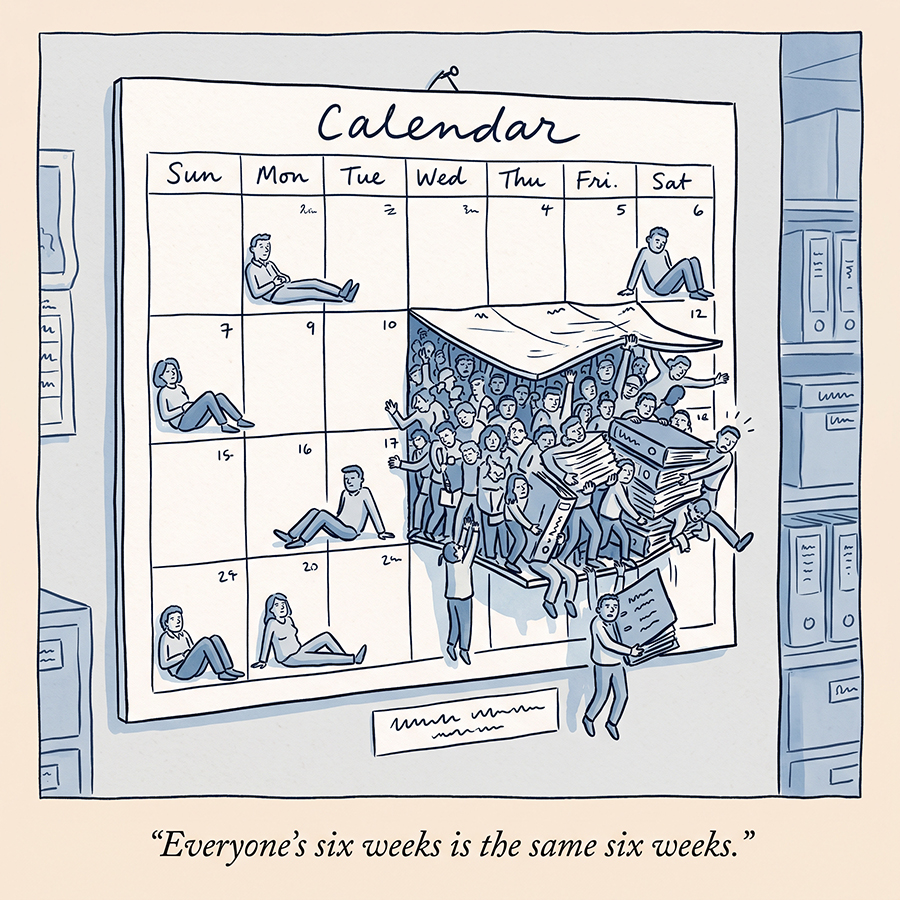
That is a manageable programme in six months. It is a difficult programme in three. It is a fire drill in six weeks, and here is the point: everyone's six weeks is the same six weeks. Specialist technical translators for the smaller EU languages are a finite pool. In Q4 2026, every machinery manufacturer that postponed this work will be drawing from that pool at the same time, alongside the LSPs serving them. Capacity pricing behaves the way capacity pricing always behaves.
There is also a sequencing trap. Translation cannot meaningfully start before the source revision is stable, and the harmonised standards will only settle late in 2026. The way through is not to wait for perfect sources. It is to split the work: translate the stable bulk of the revision on your own schedule, freeze terminology decisions deliberately and document them, and leave a thin, planned final pass for the elements that depend on late-arriving standards. That final pass is small if it was planned and enormous if it is where the whole project got deferred to.
What to Ask Your Translation Partner NowIf you manage localization or procurement for machinery documentation, five questions worth asking in 2026, in this order. Do we hold complete, current translation memories for every language version we sell, and where? Who will rule on Regulation-era terminology in each language, and against which references? How will the declaration of conformity be handled per language, as regulated formula work rather than free translation? What share of our documentation set is stable enough to translate now? And what does our partner's capacity look like in Q4 2026 versus Q2? |
A partner with real answers has thought about this transition as a programme. A partner who answers "send us the files when they are ready" is planning to meet you inside everyone else's fire drill.
The Regulation set one date for the whole industry. The manufacturers who treat 2026 as the working year will cross it with a controlled, TM-leveraged update. The ones who treat January 2027 as the start date will pay rush rates for the same words, minus the control.
Volkan Güvenç is the founder and director of Alafranga Language Solutions, a specialist translation agency working in Turkish and 40+ languages since 2002. For the regulatory side of the transition, see The EU Machinery Regulation 2023/1230: What Changes for Your Documentation in January 2027. For why running AI inside a translation programme is a discipline of its own, see Getting AI to Translate Is Easy. Getting It to Translate a Project Is Not.