How to Get a Legal Turkish-to-English Translation:
|
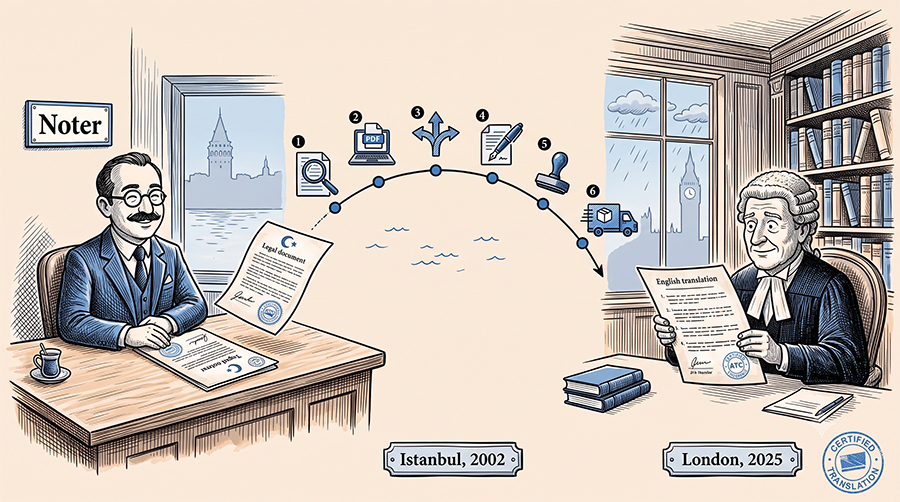
A single mistranslated clause in a contract, a power of attorney, or a court filing can delay a case, void an agreement, or send a file back from the authority that received it. Legal translation is its own discipline, and the process behind it is what protects you from those outcomes.
Our work follows ISO 17100 aligned processes, and we are members of the ATC and EUATC with certification from Bureau Veritas. What follows is the same process we use for law firms, companies, and individuals.
When you need a legal Turkish-to-English translationLegal translation covers far more than contracts. Common Turkish-to-English legal translation projects include:
|
Each of these carries its own terminology and its own expectations from the institution that will receive it. The steps below apply to all of them.
STEP 1: Send your documents for assessment
Start by sending the documents you need translated, in whatever format you have. Clear scans and photographs are fine, and so are native files such as Word or editable PDFs. We treat every file as confidential from the moment it arrives.
Start by sending the documents you need translated, in whatever format you have. Clear scans and photographs are fine, and so are native files such as Word or editable PDFs. We treat every file as confidential from the moment it arrives.
At this stage we confirm the language direction, the purpose of the translation, where the document will be used, and whether any certification is required. Telling us the destination early matters, because a document going to a court, a university, or a company abroad may need to be prepared differently.
STEP 2: Document and PDF conversion
Many legal documents arrive as scans, photographs, or locked PDFs that cannot be edited. Before translation begins, we convert these into a clean, workable format. This includes reading text from scanned or image-based PDFs, rebuilding tables and structured layouts, and reproducing the original page structure so the English version mirrors the source.
Many legal documents arrive as scans, photographs, or locked PDFs that cannot be edited. Before translation begins, we convert these into a clean, workable format. This includes reading text from scanned or image-based PDFs, rebuilding tables and structured layouts, and reproducing the original page structure so the English version mirrors the source.
This step matters more than it first appears. Contracts, certificates, and official records often rely on layout to convey meaning, and a translation that preserves that structure is far easier for the receiving party to check against the original. read more..
STEP 3: Choose the workflow that fits the document
Not every legal document needs the same level of handling. We offer three workflows so you can match the process to the sensitivity and value of the text:
Not every legal document needs the same level of handling. We offer three workflows so you can match the process to the sensitivity and value of the text:
- Human-only translation: Translated and finished by a professional legal translator, with no machine translation in the process. Our most rigorous option, suited to the most sensitive and high-stakes legal texts.
- AI-Assisted Translation with one review: Prepared using AI-assisted translation, then fully reviewed and corrected by a professional translator. A strong balance of speed, consistency, and cost for larger or less sensitive documents.
- AI-Assisted Translation with two reviews: The same AI-assisted first stage, followed by two independent rounds of human review. A second pair of eyes for projects where accuracy and consistency carry extra weight.
In every workflow, a qualified human is responsible for the final text. The difference is how many review passes stand between the draft and delivery.
STEP 4: Translation, terminology, and quality assurance
Terms of art rarely have one-to-one equivalents between Turkish and English legal language, so the translator's job is to render meaning and legal effect accurately, not to swap words. Throughout the project we keep terminology consistent across every document in the set, which is essential when a contract references defined terms or a case file spans hundreds of pages.
Terms of art rarely have one-to-one equivalents between Turkish and English legal language, so the translator's job is to render meaning and legal effect accurately, not to swap words. Throughout the project we keep terminology consistent across every document in the set, which is essential when a contract references defined terms or a case file spans hundreds of pages.
STEP 5: Certification, if your document needs it
Some documents are accepted as a plain professional translation. Others need a certified or sworn translation, and some need further steps before they are valid abroad. The exact requirement depends on the authority that will receive the document and the country where it will be used.
Some documents are accepted as a plain professional translation. Others need a certified or sworn translation, and some need further steps before they are valid abroad. The exact requirement depends on the authority that will receive the document and the country where it will be used.
We hold sworn translator credentials and handle certified Turkish-to-English translation regularly. Rather than cover the details here, we explain how certification and the steps around it work in a dedicated guide: how certification works for Turkish translations.
STEP 6: Delivery
We deliver the finished English translation in a format that matches the original as closely as possible, so it is ready to file, sign, or forward.
We deliver the finished English translation in a format that matches the original as closely as possible, so it is ready to file, sign, or forward.
How long does a legal translation take?Turnaround depends on the project. Volume, subject complexity, the condition of the source files, whether certification is needed, and the workflow you choose all affect the timeline. A short certificate and a multi-hundred-page litigation bundle are not the same task. Send us the documents and we will give you a realistic delivery time along with your quote.
|
What does it cost?Pricing depends on the same factors that shape turnaround, so we quote each project individually. You can see how our pricing is structured on our pricing page.
Find out more about pricing |
Frequently asked questions
Do you translate scanned or PDF documents?
Yes. We convert scans, photographs, and locked PDFs into an editable format before translation, and we rebuild the original layout so the English version matches the source.
Yes. We convert scans, photographs, and locked PDFs into an editable format before translation, and we rebuild the original layout so the English version matches the source.
What is a sworn or certified Turkish-to-English translation?
It is a translation issued with a formal statement or seal confirming its accuracy, which some authorities require. Whether you need one depends on where the document will be used. We cover this in our certification guide.
It is a translation issued with a formal statement or seal confirming its accuracy, which some authorities require. Whether you need one depends on where the document will be used. We cover this in our certification guide.
Will the translation keep the original formatting?
Yes. Reproducing tables, structure, and page layout is part of our standard process, so the English version stays easy to check against the original.
How fast can you deliver?
It depends on the length, complexity, condition of the files, and the workflow you choose. Send your documents for a specific delivery time.
It depends on the length, complexity, condition of the files, and the workflow you choose. Send your documents for a specific delivery time.
Are my documents kept confidential?
Yes. Every file is treated as confidential from the moment you send it.
Yes. Every file is treated as confidential from the moment you send it.
Further readings:
Why Translating from English into Turkish Is Harder Than Most Briefs Assume
Why Turkish Is Not Just Another European Language for Technical Translation
When Terminology Inconsistency Becomes a Real-World Problem
Why Turkish Legal Translation Demands Ongoing Legal Literacy
How to Choose a Turkish Translation Partner for Technical Documentation
Turkish Legal Translation Services