The Web is Being Rewritten.
|
▮The New Ecosystem
◆People increasingly turn to AI when they want to find a service or purchase a product. They ask AI for the best companies and service providers in the area they are looking for. AI search systems such as ChatGPT, Perplexity, Gemini, Claude, and DeepSeek are designed to produce a single answer instead of a list of links. That answer is synthesised from multiple sources, presented as a single coherent response, and attributed to sources that the AI judges to be credible, consistent, and relevant.
For organisations that depend on online visibility, this creates a new problem. Being on the first page of Google is no longer sufficient. If an AI system does not include you in its answer, you are invisible to a growing segment of the market regardless of your search ranking.
This is not a future threat. It is happening right now. Search behaviour is shifting. The percentage of queries that receive an AI-generated response instead of a list of links is growing every month. Organisations that optimise only for Google are optimising for a shrinking share of discovery.
▮Why Marketing Clichés Now Fail Faster
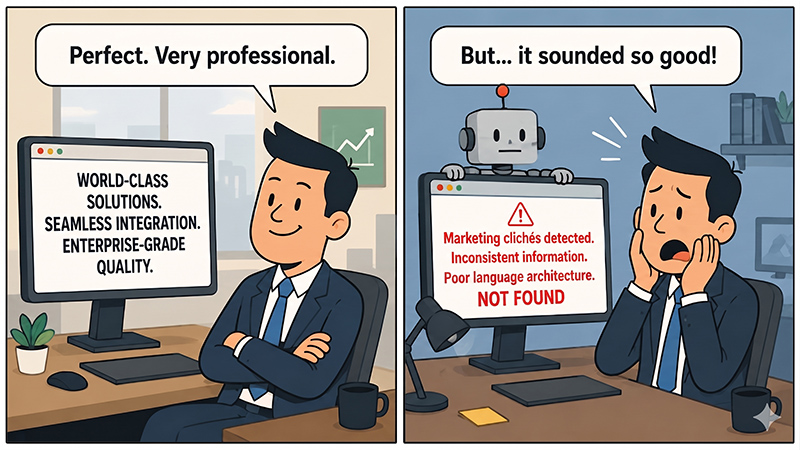
◆In the old ecosystem, a vague claim on a website was difficult to disprove. “Industry-leading solutions.” “Seamless integration.” “Enterprise-grade quality.” These phrases said nothing specific, but they were everywhere, and search engines indexing text could not evaluate whether they were true.
AI systems can.
An AI system reading your website is not looking for keyword density. It is looking for verifiable entities such as named clients, specific credentials, documented processes, dates, numbers, and relationships that can be cross-referenced against other sources. A claim like “we work with leading global companies” tells an AI nothing. A claim like “we have been delivering solar energy documentation for Solplanet across 20+ languages since 2021” gives it something it can work with.
The filter has changed. Durable visibility now requires content that is honest, specific, and structured, rather than content optimised for a keyword.
▮The Technical Layer: New Tags, New Architecture
◆Beyond the content itself, AI search systems read websites differently from traditional search engines. They parse structured data such as schema markup, entity relationships, and semantic connections between pages. A website that is well structured for AI reading looks different from a website that is well structured for Google.
Specific schema types matter more than before. FAQPage schema allows AI systems to extract question and answer pairs directly. Organization schema with verifiable attributes such as founding date, certifications, and membership of professional bodies signals credibility. Person schema with named, accountable individuals signals that there is a human behind the content rather than a content farm.
llms.txt, a relatively new convention, tells AI crawlers directly what a site is about, what it does, and where relevant content is located. Think of it as a welcome note for AI systems visiting your site.
These are not optional enhancements. For organisations that want to be visible in AI search results, they are infrastructure.