Web & App Localization Agency
Websites, Apps and Digital Content Localized for the Market, Not Just Translated
|

|
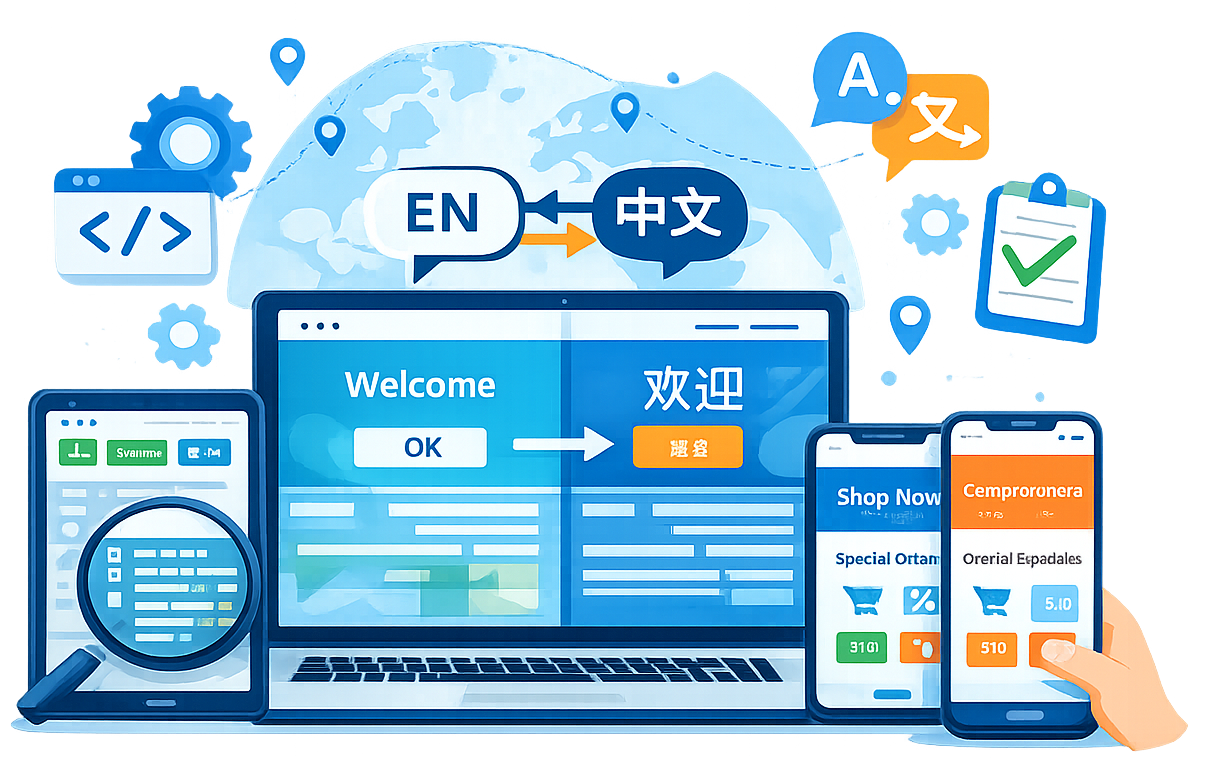
More than a vendor. A specialist team. Every project starts with the right match — not the next available translator. We assign a lead specialist with real subject-matter experience in your content type, supported by an independent reviewer, a project manager, and QA at every stage. You get a named contact, a defined process, and terminology that carries across every document we handle for you. |
▮Web localization services
Learn more anout web localization →
▮Software localization services
Our software localization workflow is built around your development environment. We handle string extraction, in-context review, pluralization logic, and linguistic validation before release, not after.
Learn more about softtware localization →
▮Subtitling & Timed-Text Localization Services
We support:
- Subtitle translation and adaptation
- Time-coded synchronization
- Platform-specific formatting
- SDH (Subtitles for the Deaf and Hard of Hearing)
- Multilingual version management
- Consistency across episodes and seasons ensures brand continuity.
Learn more about media localization→
▮Questions We Hear Before Every Project
- What is the difference between translation and localization? Translation converts text from one language to another. Localization adapts a product — its interface, content, and behaviour — for a specific market. A localized website does not just replace English words with their equivalents. It adapts headlines and CTAs for local conversion intent, optimizes metadata for local search behaviour, and ensures compliance-sensitive content meets local legal expectations. A localized app handles text expansion without breaking layouts, protects placeholders from accidental modification, and validates content within the actual interface before release. Localization is not translation with extra steps. It is a system-level discipline where linguistic precision, interface constraints, release cycles, and terminology governance all operate simultaneously.
- Which localization services do you offer? We offer multilingual web localization: CMS-integrated, SEO-adapted, metadata-optimized, covering corporate sites, landing pages, product pages, help centers, and legal web content. We offer software and app localization: String extraction, in-context review, pluralization logic, and linguistic validation built around your development environment. We also offer subtitle and timed-text localization for media, AV, and broadcast content. All three services draw from the same terminology governance framework — shared glossaries and translation memories — ensuring consistency across web, product, and media in every language.
- Which languages do you cover for localization? Turkish is our founding language pair for localization, active since 2002. Around it, we work on multilingual localization projects across 40+ languages including German, French, Italian, Spanish, Dutch, Polish, Romanian, Arabic and Greek. For multilingual software products requiring multiple language pairs simultaneously, we manage all pairs through a single point of contact with shared glossaries, UI terminology governance, and consistent string-level terminology across all localized versions.