|
Who owns the problem when your multilingual technical project goes wrong?
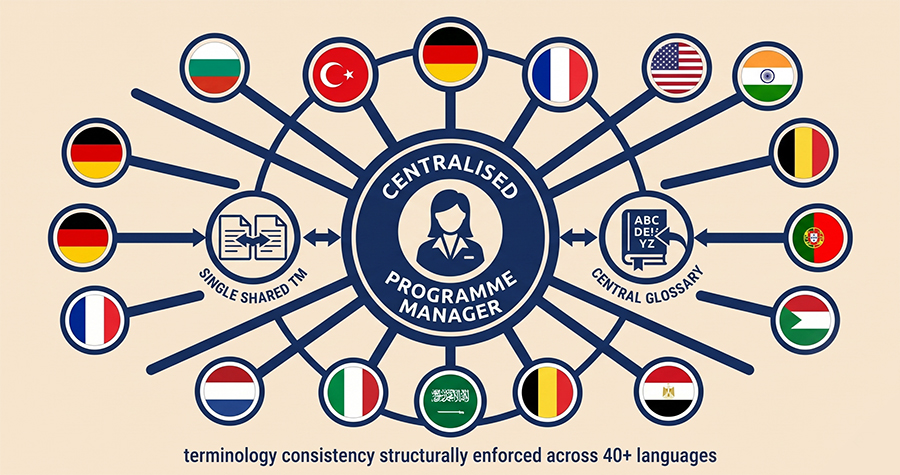 The answer depends entirely on how you organised the work — and most programmes are organised without ever asking that question.
Multilingual technical projects produce predictable problems: terminology that diverges across languages, instructions that don't reach every team, institutional knowledge that accumulates in silos, and accountability that belongs to everyone in theory and nobody in practice. These problems have structural causes. And they have structural solutions — different ones, depending on your content, your languages, and what the documentation will be used for. We work with three organisational models for multilingual programmes. Each solves part of the problem. Each leaves a different part unresolved. The comparison below sets out what each model actually delivers — so you can match the structure to your situation before the project begins, not after something goes wrong. |
| Model 1 — Distributed Specialist agency per language |
Model 2 — Single agency Full language capacity |
Model 3 — Hybrid Coordinator agency + specialist sub-vendors |
|
|---|---|---|---|
| How it works | Each target language is assigned to a separate agency operating in that language market — a German agency for German, a Turkish agency for Turkish, and so on |
All target languages are handled by one agency — one PM, one contract, one point of contact across all languages | One coordinating agency manages the programme and sub-contracts individual languages to specialist agencies or freelancers in each language market |
| PM language knowledge | Strong — the PM at each agency works in their own language, knows the conventions, can read the output |
Variable — the coordinating PM may know one or two languages well; for others, they are managing process rather than content.For large-scale programmes, a PM with native-level fluency is assigned as an in-language lead |
Split — the coordinator manages process; language-level quality is delegated to sub-vendors |
| Ability to read and assess output | ✅ High — PM can directly evaluate translation quality in their language | ⚠️ Partial — PM can assess languages they know; for others, quality assurance depends on second reviewer, technology, or trust. ✅ Where necessary, an native PM embedded in the workflow reads and assesses output directly in the target language. |
⚠️ Partial at coordinator level — sub-vendor PM can assess their own language; coordinator cannot |
| Terminology consistency — within one language | ✅ Strong — single agency maintains its own TM and glossary for that language |
✅ Strong — single TM and glossary applied across all translators on the project | ✅ Strong within each sub-vendor — each maintains their own TM for their language |
| Terminology consistency — across languages | ❌ Structural weakness — each agency operates its own TM; no shared reference point across languages | ✅ Possible — single coordinating agency can maintain a master glossary and enforce it across all language pairs | ⚠️ Dependent on coordinator discipline — master glossary can be issued but enforcement across independent sub-vendors requires active monitoring |
| Corporate terminology preferences — how they are applied | Brief issued separately to each agency — each interprets and applies independently | Brief issued once — applied centrally to shared TM and glossary, enforced at prompt level for AI-assisted workflows |
Brief issued by coordinator — transmitted to sub-vendors; interpretation may vary across agencies |
| Corporate terminology preferences — retention across projects | Each agency retains preferences in their own TM — not shared across agencies; next project requires re-briefing each agency separately |
✅ Retained centrally — client TM and glossary updated after every project, automatically applied to all future work across all languages | Retained by sub-vendors individually — coordinator may hold a master reference but enforcement at sub-vendor level is not guaranteed |
| Translation memory — architecture | Multiple independent TMs — one per agency, one per language | ✅ Single shared TM — all languages in one infrastructure; real-time synchronisation possible for team projects |
Multiple TMs at sub-vendor level — coordinator may maintain a master TM but it is not the working TM of the translators |
| Glossary governance | Each agency maintains its own glossary — alignment across agencies depends on how well the client brief is written and followed |
✅ Single client glossary — applied and maintained centrally, updated as client terminology evolves | Coordinator issues master glossary — sub-vendors apply it to varying degrees; no structural enforcement mechanism |
| Who enforces terminology decisions | Nobody centrally — each agency is accountable only for their own language | ✅ The coordinating PM — one person or team with visibility across all languages and authority over the shared TM |
The coordinator in theory — but no direct control over sub-vendor TMs or workflows |
| New terminology decision mid-project | Must be communicated to each agency separately — risk of inconsistent adoption | ✅ Applied once — updated in shared TM and glossary, immediately available to all translators across all languages |
Must be communicated to coordinator, then transmitted to each sub-vendor — adoption timing and consistency variable |
| ISO 17100 compliance | ✅ Possible — each agency certified independently | ✅ Possible — single certification covers all languages if the agency holds it | ⚠️ Depends on sub-vendor certifications — coordinator may be certified but sub-vendors may not be |
| Independent review | ✅ Each agency applies its own review process | ✅ Applied centrally — same review standard across all languages | ⚠️ Applied at sub-vendor level — review standard varies by sub-vendor |
| Quality assurance for languages PM cannot read | Not applicable — each agency PM reads their own language | ⚠️ Structural limitation — second reviewer, automated QA (terminology checks, numerical accuracy, formatting), and client domain expert review are the available mechanisms. ✅This limitation is addressed structurally: a senior in-language translator takes a project management role, providing direct oversight rather than process-only control. |
Not applicable at sub-vendor level — sub-vendor PM reads their language; coordinator cannot assess language quality directly |
| Automated QA tools | Applied independently by each agency — output may differ | ✅ Applied centrally across all languages — consistent QA parameters, same tools, same thresholds |
Applied by sub-vendors — consistency across agencies not guaranteed |
| File engineering and DTP | Each agency handles their own language — consistency of DTP output across languages not guaranteed | ✅ Managed centrally — consistent file engineering, layout, and DTP across all languages | Managed by sub-vendors — DTP consistency across languages depends on coordinator's ability to specify and enforce output requirements |
| Single point of contact | ❌ No — one contact per agency, one contract per language | ✅ Yes — one PM, one contract, one invoice | ⚠️ Partial — one coordinator contact, but multiple sub-vendor relationships exist behind the scenes |
| Contract and invoice management | One contract and invoice per agency — multiplied by number of languages | ✅ One contract, one invoice — all languages |
One contract with coordinator — sub-vendor contracts managed by coordinator, not client |
| Accountability when something goes wrong | Localised — the agency responsible for that language is accountable; cross-language inconsistency has no single owner | ✅ Centralised — one agency is accountable for all languages and all cross-language consistency | Split — coordinator accountable for programme management; sub-vendor accountable for language quality; cross-vendor inconsistency may fall between the two |
| Transparency into workflow | High within each agency — opaque across agencies | ✅ High — single agency, full visibility into all workflows |
⚠️ Variable — coordinator workflow visible; sub-vendor workflows may not be |
| Speed — project initiation | Slower — brief, assets, and instructions must be issued to each agency separately | ✅ Faster — single briefing, single asset transfer, single kickoff |
Medium — coordinator briefing is single; sub-vendor activation adds a layer |
| Speed — mid-project changes | Slowest — changes must reach each agency and be confirmed by each | ✅ Fastest — change applied once, propagates through shared infrastructure |
Medium — coordinator receives change; sub-vendor adoption timing varies |
| Cost profile | Higher per language — specialist agency rates; multiplied coordination overhead for the client | Variable — volume pricing possible; coordination overhead absorbed by the agency |
Variable — coordinator margin added to sub-vendor rates; specialist rates at sub-vendor level |
| Best for | Regulated content where language-specific legal or compliance knowledge is critical — where the PM must be able to read and assess the output directly | High-volume technical programmes where cross-language terminology consistency is the primary challenge — and where one point of accountability is operationally important |
Large programmes where language-specific expertise is non-negotiable and the client needs a single commercial relationship — provided the coordinator has genuine sub-vendor governance mechanisms |
| Weakest point | Cross-language terminology consistency — nobody owns it structurally | Quality assurance in languages the PM cannot read — managed through process, not direct assessment | Terminology enforcement across sub-vendors — the coordinator can issue a glossary but cannot guarantee how it is applied |
| Where Alafranga sits | Alafranga operates as a specialist agency in this model for Turkish — and for the languages in our active network where we have verified domain specialists | Alafranga operates in this model for multilingual programmes — Turkish at the core, 40+ languages, single TM and glossary infrastructure, one PM, one contract | Alafranga operates as the coordinating agency in this model for programmes requiring language-specific expertise beyond our active network — with explicit sub-vendor governance and shared glossary enforcement as contractual requirements |