CE Compliance in Turkish: Why the Machinery Directive Does Not End at the BorderBy Vedat Güven — Mechanical Engineer, Technical & Quality Advisor — Alafranga Language Solutions
Across a career spanning aerospace and defence, oil and gas, energy, automotive, and heavy industry, he has held active roles in supplier quality assurance, quality management, QA/QC, test and verification systems, non-destructive testing (NDT), HSE, and international audits.
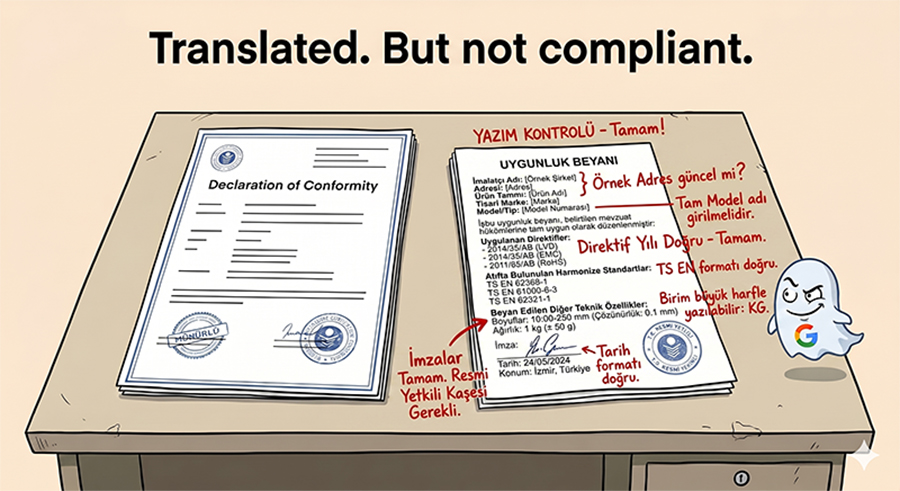 A CE mark on a machine means that the manufacturer has declared conformity with the applicable European directives — that the machine meets the essential health and safety requirements, that a technical file exists, that the conformity assessment procedure has been completed. For most European markets, the CE mark is the end of the documentation process. |
For Turkey, it is the beginning of a second one.
Turkey has implemented the EU Machinery Directive through domestic legislation — the Makine Emniyeti Yönetmeliği (Machine Safety Regulation), published under the Official Gazette and maintained by the Ministry of Labour and Social Security. The regulation is structurally aligned with Directive 2006/42/EC. The essential health and safety requirements are the same. The conformity assessment procedures are the same. A CE-marked machine exported to Turkey is generally recognised without re-certification.
What is not recognised is documentation in any language other than Turkish.
The Turkish regulation is explicit: the instructions for use — kullanım kılavuzu — must be provided in Turkish. This is not a market preference or a distributor requirement. It is a legal obligation, and it applies to every machine placed on the Turkish market, regardless of whether the machine also carries a CE mark and regardless of whether full documentation in other languages is also provided.
For European manufacturers with established CE documentation processes, this creates a specific and recurring problem. The technical file exists. The instructions are complete. The declaration of conformity is signed. And then, at the point of market entry into Turkey, the documentation process has to begin again — in Turkish, against Turkish regulatory expectations, with terminology requirements that the European documentation process was not designed to address.
What the Turkish regulation actually requiresThe Makine Emniyeti Yönetmeliği requires that machinery placed on the Turkish market be accompanied by instructions in Turkish covering, at minimum: the intended use and foreseeable misuse of the machine, the assembly and installation conditions, commissioning and operating procedures, maintenance and repair instructions, information about residual risks, and the warning and safety information required by the applicable essential health and safety requirements.
|
This is, structurally, the same content that the EU Machinery Directive requires in the instructions for use. The difference is that in Turkey, this content must be in Turkish — and it must be such that it meets the terminology expectations of Turkish technical regulators and, where applicable, Turkish standards bodies.
The declaration of conformity — uygunluk beyanı — must also be provided in Turkish. This document follows a specific format defined in the regulation, including the exact wording of the declaration statement. A declaration of conformity translated from a European language without reference to the format requirements of the Turkish regulation will frequently contain wording that is technically accurate but does not match the expected regulatory formula — which creates questions during customs clearance or market surveillance inspection that would not otherwise arise.
Beyond the Machinery Directive, machines placed on the Turkish market may also be subject to Turkish standards — TS EN adoptions of the harmonised European standards — and the documentation may be expected to use the terminology defined in those standards. The relationship between CE harmonised standards and Turkish TS EN adoptions is close but not identical, and the terminology alignment requires active verification rather than assumption.
The technical file is not a translation projectThis is the point where the framing of the task matters most.
European manufacturers typically think of Turkish-language documentation as a translation project: take the existing CE documentation, translate it into Turkish, distribute it with the product. This framing is understandable. It is also the source of most of the problems that surface later.
|
A CE technical file is a structured body of documentation — drawings, calculations, risk assessments, test reports, the instructions for use, the declaration of conformity, and the supporting technical records. Not all of it needs to be translated for Turkish market entry. What needs to be translated, and how, depends on the product category, the applicable directive or regulation, the nature of the Turkish customer relationship, and whether the product will be subjected to market surveillance.
The instructions for use must be in Turkish — this is non-negotiable. The declaration of conformity must be in Turkish — also non-negotiable. The rest of the technical file may remain in the original language, provided that it is available for inspection if Turkish market surveillance authorities request it. But the documents that accompany the product to the end user must be in Turkish, and those documents must be correct — not just linguistically, but in terms of format, terminology, and regulatory alignment.
Treating this as a straightforward translation project — send the files, receive the Turkish text, attach to the product — produces documentation that is translated but not necessarily compliant. The distinction only becomes visible when something goes wrong: a customs question, a market surveillance inspection, an incident involving the machine, a distributor who needs to submit documentation to a Turkish authority.
Where Turkish documentation most often failsIn twenty-three years of working with Turkish technical documentation for European manufacturers, the failure points are consistent and predictable.
|
Declaration of conformity wording. Uygunluk beyanı, in Turkish, has a defined format and defined language. The phrase used to declare conformity, the way the manufacturer's identity is stated, the way the applicable directives are referenced, and the format of the authorised representative's statement all follow conventions defined by Turkish regulatory practice. A declaration of conformity translated from German or English without reference to these conventions will often contain wording that is semantically correct but formally non-standard — visible to a Turkish customs officer or market surveillance inspector as documentation that was not prepared by someone who knew what Turkish regulatory documentation looks like.
Safety warnings and signal words. ISO 3864 and ANSI Z535 define the signal words — DANGER, WARNING, CAUTION — and their hierarchical relationship. The Turkish equivalents — TEHLİKE, UYARI, DİKKAT — are defined in the Turkish adoptions of these standards. A translation that renders WARNING as UYARI in one place and İKAZ in another — both are plausible translations — creates an inconsistency that signals unfamiliarity with the applicable standards. Wording preference may be up to the age or social class of the translator. Although İKAZ being old fashioned but may still be favored In safety documentation, signal word consistency is not a style preference; it is a safety requirement.
Residual risk statements. The essential health and safety requirements of the Machinery Directive require that instructions include information about residual risks that cannot be eliminated by design or safeguarding. The language used in these statements — the way the risk is described, the way the required protective measures are specified — follows conventions in Turkish technical documentation that a general translator may not know. Residual risk statements translated too literally from German or English often read awkwardly in Turkish and fail to communicate the required information in the way a Turkish operator or safety officer would expect to receive it.
Maintenance and service intervals. Numerical values — torque specifications, pressure ratings, temperature ranges, service intervals — survive translation intact, but the units and the way they are expressed may not. Turkey uses SI units, but the conventions for expressing values in Turkish technical documentation — decimal separators, the way unit symbols are spaced relative to values, the abbreviations used for Turkish-language unit names in instructional text — differ from German and English conventions. A maintenance manual that uses a full stop as a decimal separator throughout, or that uses English unit abbreviations in Turkish instructional text, is immediately recognisable as a document that was not prepared by a translator who works regularly with Turkish technical documentation.
Partly assembled machinery and the special declarationThe Machinery Directive includes a specific provision for partly assembled machinery — components or sub-assemblies that cannot function independently and are intended to be incorporated into a complete machine. For partly assembled machinery, the Machinery Directive requires a declaration of incorporation rather than a declaration of conformity, and requires that the manufacturer supply assembly instructions that enable the machinery to be safely incorporated.
|
The Turkish regulation mirrors this structure. The provisions for kısmi tamamlanmış makine (partially completed machinery) follow Directive 2006/42/EC closely, including the requirement for a declaration of incorporation — dahil etme beyanı — in Turkish.
This matters because partially assembled machinery is common in industrial supply chains. A European manufacturer supplying a sub-assembly to a Turkish systems integrator, or a Turkish machinery builder incorporating European components, will encounter this provision. The documentation requirement is frequently overlooked — partly because the partially assembled machinery provisions are less prominently discussed than the main machinery requirements, and partly because the terminology in Turkish (kısmi tamamlanmış makine, dahil etme beyanı) is unfamiliar to European documentation teams who have not previously worked with Turkish regulatory documentation.
The distributor gapA structural feature of how Turkish market entry works is that European manufacturers frequently rely on Turkish distributors to handle the documentation requirement. The distributor, who knows the Turkish market, is assumed to handle the Turkish documentation. This assumption is often correct in practice — the distributor commissions a translation, attaches it to the product, and the documentation requirement is met in a nominal sense.
|
What the distributor is rarely equipped to do is verify that the translation meets the terminology requirements of the applicable TS EN standards, that the declaration of conformity follows the correct regulatory format, that safety signal words are used consistently and correctly, or that maintenance documentation uses the unit conventions of Turkish technical writing. The distributor's criterion for acceptable documentation is typically whether the Turkish text reads coherently — not whether it is compliant with the applicable standards and regulatory conventions.
For a European manufacturer, this means that compliance of documentation for the Turkish market is effectively unmonitored unless the manufacturer takes specific steps to ensure it. The product is on the Turkish market. The documentation is in Turkish. The distributor is satisfied. And the documentation may still contain the kinds of errors that create problems during market surveillance, during a product liability event, or when the end user needs to submit documentation to a Turkish authority.
What correct Turkish CE documentation looks likeA correctly prepared Turkish CE documentation package for machinery begins before translation. It begins with identification of the applicable directives and their Turkish implementations, the applicable TS EN standards, and the specific format requirements for the declaration of conformity under Turkish regulatory practice.
|
It continues with translation that uses the terminology of the applicable TS EN standards — not general Turkish, not the translator's preferred renderings, but the normative terms defined in the standards that apply to the product. Safety signal words are verified against the Turkish adoptions of ISO 3864 and ANSI Z535. The declaration of conformity is formatted to Turkish regulatory conventions. The instructions for use are reviewed not just for linguistic accuracy but for the specific content requirements of the Turkish Machinery Regulation.
This is the documentation process that a European manufacturer would recognise as correct for their own market — applied to Turkey. It requires a translation partner who knows the Turkish regulatory framework, has access to the applicable standards, and understands the difference between a translation that reads correctly in Turkish and a translation that functions correctly as regulatory documentation.
We have been preparing Turkish CE documentation for European manufacturers since 2002 — machinery manuals, declarations of conformity, safety documentation, and technical files for clients including Rolls-Royce, Siemens Gamesa, and Schell GmbH. If you are preparing Turkish documentation for a CE-marked product and want to discuss the specific requirements, we are happy to do that before the translation begins.
→ Turkish Technical Translation — how we work