EU Moves High-Risk AI Deadline to December 2027.
The Transparency Rules Applied on Schedule.
By Volkan Güvenç, terminology and compliance documentation, 21 August 2026
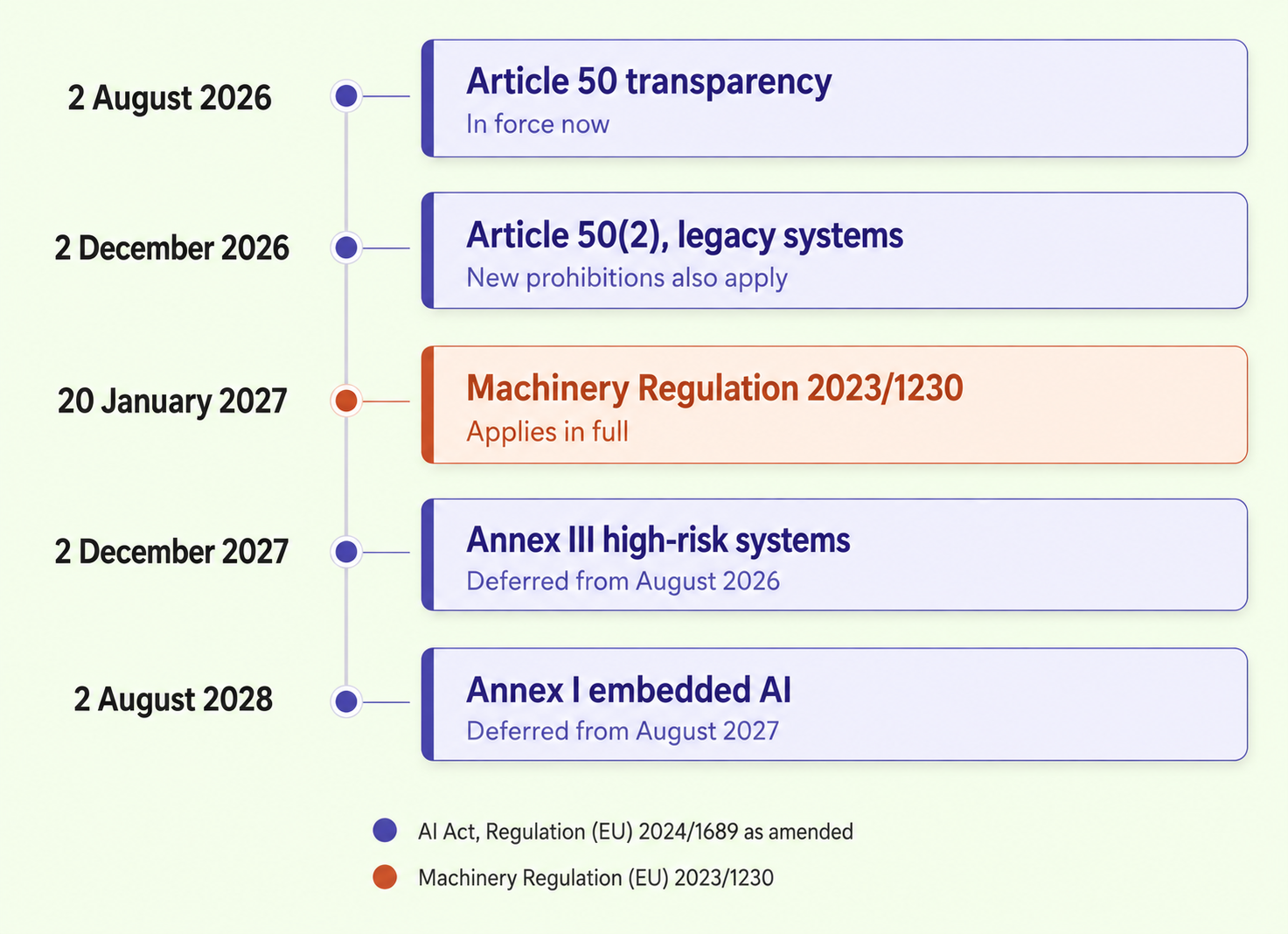
Six days before the AI Act's high-risk obligations were due to bite, the date changed. The Digital Omnibus on AI, Regulation (EU) 2026/1744, entered into force on 27 July 2026. It moved the compliance deadline for standalone high-risk systems under Annex III from 2 August 2026 to 2 December 2027, and pushed AI embedded in products already covered by EU product safety law under Annex I out to 2 August 2028. Secure Privacy
Most of the coverage read as though the AI Act had been postponed. It has not. Article 50 was left untouched and its transparency obligations applied from August 2026 as originally written. Systems already on the market before that date have until 2 December 2026 to meet the Article 50(2) marking requirement, and the prohibited practices newly added to Article 5 carry the same December date. Secure PrivacyEU Artificial Intelligence Act
So the obligation that reaches the largest number of companies is already live, and the one everybody was counting down to has moved.
What the language obligations actually say
Article 13 requires a high-risk system to arrive with instructions for use that are concise, complete, correct and comprehensible to the deployer. Recital 72 supplies the part that matters once a product crosses a border: those instructions should be in a language the deployer can easily understand, as determined by the Member State where the deployer operates. EU Artificial Intelligence ActAlgolia
Article 50 sets a different test. The disclosure has to reach the person exposed to the system, clearly and distinguishably, at the latest at first interaction, and it has to meet applicable accessibility requirements. An English-only notice inside a terms page fails both parts of that sentence for a user in Warsaw or Lisbon. This is not a 2027 problem.
Where the calendars collide
Machinery is the awkward case. Regulation (EU) 2023/1230 applies from 20 January 2027, and Annex I AI obligations follow on 2 August 2028. A manufacturer placing a machine with an AI safety component on the EU market opens the same technical file twice inside nineteen months, in every market language, under two different regulatory logics.
The risk there is not mistranslation. It is drift. Two revision rounds without a maintained memory and a governed glossary produce two wordings of the same warning inside one document.
We do not need a regulatory deadline to see how this behaves. Between January and July 2022 we translated three released versions of the same Solplanet inverter user manual, UM0014 for the ASW 3-20K-LT-G2 Pro. A second manual in the same family reached version four inside eighteen months. That release cadence is what an actively developed product line looks like, and AISWEI, the manufacturer behind the Solplanet brand, was documenting it properly. The point is what happens to the languages. The target sets were not identical from one version to the next, so by the fourth release no single language had followed the document through its full revision history. Nothing went wrong in those projects. The exposure is not created by a bad revision round. It is created by the number of rounds and by the language sets shifting underneath them. Two overlapping regulatory calendars compress that arithmetic rather than changing it.
We translate the documents these deadlines land on: instructions for use, technical files, risk assessments, interface strings, disclosure notices. Sixteen extra months on Annex III is not a pause. It is the window in which the terminology gets fixed, before three regulations start reading the same file.
Our coverage of the EU Machinery Regulation 2023/1230 is [here](internal link).
Legislation referenced: Regulation (EU) 2024/1689, Articles 13 and 50 and Recital 72; Regulation (EU) 2026/1744; Regulation (EU) 2023/1230. Dates verified against the Official Journal on 21 August 2026.