Turkish series are sold to broadcasters and platforms in Europe, the Middle East, Latin America and beyond. Most language versions are built from one English subtitle template, so a mistake in that template travels into every market. Alafranga has worked from Turkish since 2002. We prepare English templates, dubbing scripts and catalogue metadata from the Turkish original, and we review subtitles produced elsewhere against it. |
|
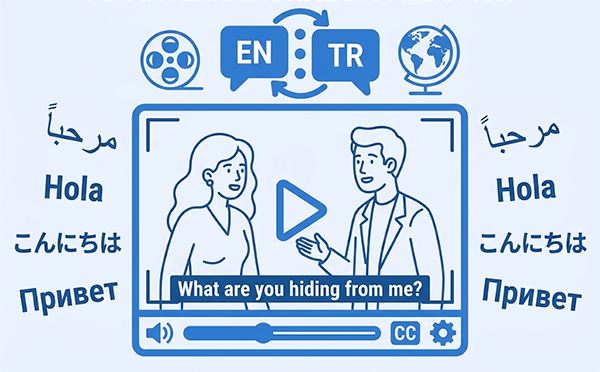
One template, every language
A 100-episode series sold into 20 markets goes through one English template and 20 translations of it. A line misread in Turkish is misread 20 times, and nobody downstream can see it, because nobody downstream reads Turkish. Checking at the template stage costs a fraction of correcting 20 language versions after delivery.
|
▮What We Deliver
- English pivot templates Timed English subtitles from the Turkish original, written for reading speed and for translation into further languages. Idioms are rendered so that a French or Polish translator can carry them on, forms of address are handled the same way in every episode, and cultural references are made clear without footnotes.
- Review of existing subtitles and AI output Review of English or European-language subtitles produced by another supplier or by AI, against the Turkish source. We correct meaning errors, flag timing problems and return a short report of what we found, by type and by episode.
- Dubbing scripts for European markets German, French, Italian and Spanish dubbing scripts prepared from the Turkish source through our specialist network, with one glossary for character names, places and recurring terms across the whole series.
- International catalogue metadata English titles, synopses and cast and crew credits: a decision to keep, translate or romanize each title, names with ç, ğ, ı, ö, ş and ü that work in international content systems, and synopses rewritten for viewers who do not share Turkish family and social codes.
- SDH for European broadcasters Subtitles for the deaf and hard of hearing in European languages. Since 28 June 2025, the European Accessibility Act has required services that give access to audiovisual media to provide them in the language of each market.
▮What Turkish Drama Asks of a Translator
- Forms of address carry the relationships. Abi, abla, hanım, bey and efendim tell the viewer who respects whom, who is family and who is not. Dropped, they flatten the story; translated literally, they confuse it. Each series needs one rule, set in episode 1 and kept to the last episode.
- Long episodes, long runs. Episodes often run past 100 minutes and series past 100 episodes, split between several translators. A character's way of speaking has to read the same in episode 3 and episode 103. That takes a series glossary and a reviewer who reads across episodes, not only within them.
- Expressions with no direct equivalent. Blessings, oaths, proverbs and religious expressions such as inşallah and maşallah appear in almost every scene. Whether to keep, explain or replace them is a decision for the whole series, made once and written down, not left to each translator.
- Names and titles that must travel. A title has to work in a catalogue in 20 countries. Character and place names have to survive systems that do not handle Turkish letters, and stay the same in subtitles, dubbing scripts and metadata.
▮Experience
Through a global media localization partner, we wrote English metadata for more than 30 Turkish drama, comedy and lifestyle productions entering Disney's catalogue for Central and Eastern Europe, the Middle East and North Africa: titles, synopses and credits under Disney's formatting rules.
In the other direction, we subtitled 647 Disney episodes and films, about 333 hours, into Turkish in five weeks, with more than two dozen subtitlers working in parallel and three review stages per file. The team and the review routine behind that programme are the ones we put on Turkish drama. Read the case study
▮How We Work with Distributors
- A series glossary first. Character names, forms of address, recurring expressions and place names, agreed with you before episode 1 and shared with every translator and reviewer.
- Delivery to your schedule. For simultaneous or near-simultaneous airing, episodes are split between translators on one shared glossary and delivered in batches.
- AI under control. AI can draft where it helps. A named specialist reviews every line against the Turkish source, and unedited AI output is never delivered.
- Start with a test. Send ten minutes of an episode. We return a template or a review report, so you can judge the work before you commit.
▮Questions from Distributors
Why work from the Turkish source rather than an existing English version? Every further language is built on the English template. A meaning error in the template is copied into all of them, and translators working from English cannot see it. Working from Turkish catches it once, at the first step.
Can you review English subtitles produced by another supplier or by AI? Yes. A specialist compares the subtitles with the Turkish source, corrects meaning errors and flags timing problems, and we return a short report of what we found by type and by episode.
Which languages do you cover for Turkish drama? English templates and metadata from Turkish, and dubbing scripts and subtitles in German, French, Italian and Spanish through our specialist network. Other languages are available on request.
How do you keep a long series consistent across translators? With a series glossary agreed before episode 1, covering character names, forms of address, recurring expressions and place names, and with a reviewer who reads across episodes, not only within them.
How can we test the work? Send ten minutes of an episode. We return an English template or a review report, so you can judge the work before you commit.