|
Getting AI to Translate Is Easy. Getting It to Translate a Project Is Not.
By Volkan Güvenç, the founder and director of Alafranga Language Solutions, a specialist translation agency working in Turkish and 40+ languages since 2002. For how AI-assisted and human workflows are structured at Alafranga, see our translation workflow tiers. For the terminology and compliance side of Turkish technical documentation, see Compliance in Turkish. Anyone can get AI to translate a paragraph. Paste the text, pick the language, receive something fluent in seconds. This works, and it works well enough that many people now believe translation has become a solved problem.
|
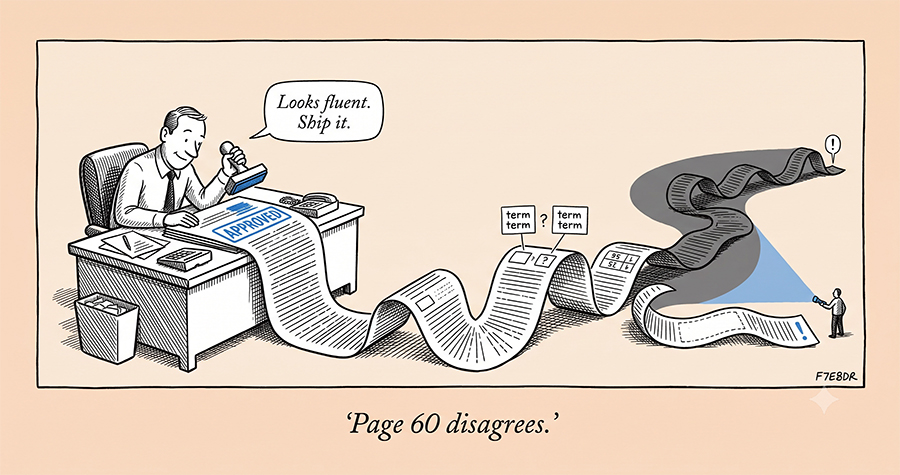
Then the same person uploads an 80-page machinery manual, receives 80 pages of fluent Turkish, checks the first ten pages, and approves the job. What happens next is the subject of this article, because I have spent the last four years running AI-assisted translation in production, and I can tell you exactly what happens next.
|
What Happens on Page 60
Large documents expose a failure mode that short texts never show. The model starts strong. Somewhere in the middle, quietly, things begin to drift.
|
The term it rendered as "emniyet kilidi" in chapter one becomes "güvenlik kilidi" in chapter six. Both are correct Turkish. Both are fluent. But a safety lock that changes its name halfway through a maintenance manual is no longer one component; to the technician reading the document, it might be two. Numbers and units start slipping in dense tables. Occasionally a sentence simply disappears, and nothing in the output signals that it did.
The critical point is not that these errors happen. It is where they happen. They are buried deep in the document, past the point where anyone doing a quick review will look. A spot check of the first ten pages tells you nothing about page 60. Catching this requires knowing that it happens, knowing where to look, and knowing what to look for.
Fluency is the only quality signal a non-specialist has. And fluency is precisely the signal AI never fails to produce. The output that confuses joint surety with simple surety in a contract reads just as smoothly as the output that gets it right. Confident wrongness is the default failure mode, and it is invisible to anyone who cannot independently judge the content.
|
Where It Gets Harder: The Project Layer
A single document is the easy case. Real translation work rarely arrives as a single document. It arrives as a project: a documentation set, a contract bundle, a product release across several languages. At this scale, a new class of problems appears that has nothing to do with how well the AI translates a sentence.
|
The CAT tool problem. Professional translation runs inside tools like MemoQ and Trados for good reasons: translation memory, terminology enforcement, tag protection, version control. But run AI inside these tools and it translates segment by segment, seeing one isolated sentence at a time, blind to the document around it. Run AI outside these tools on the full document and you gain context but lose everything the tools protect: TM matches, glossary enforcement, formatting tags, the ability to lock what was already approved. Deciding which content goes through which route, and how translation memory and terminology reach the AI at all, is not a settings menu. It is engineering judgment, made per project, and made wrongly by default when nobody makes it at all.
The terminology conflict problem. A client comes to us with ten years of translation memory that says "valf." The AI, drawing on its training, prefers "vana." Both are correct. A manual that uses both is not correct; it is two half-manuals stapled together. Someone has to decide which source of truth wins, when exceptions apply, and how the decision gets enforced across every file in the set. AI does not make governance decisions. It just produces plausible text on both sides of the conflict.
The regulatory problem. Turkish safety documentation distinguishes signal words under adopted international standards: TEHLİKE, UYARI, DİKKAT. A declaration of conformity follows a specific formula. Correct Turkish and compliant Turkish are not the same thing, and AI reliably delivers the first while knowing nothing of the second. My colleague Vedat Güven has written in detail about what this looks like in CE documentation. The short version: the errors that pass a fluency check are exactly the ones that fail a market surveillance check.
|
Where It Gets Harder Still: The Team Layer
Now add a deadline. A 300,000-word technical set, four translators working in parallel, AI drafting in the pipeline, a shared translation memory updating in real time.
|
Here is what non-specialists consistently underestimate: AI accelerates production, and in doing so it accelerates error propagation. A wrong term approved on Monday morning is in forty files by Tuesday. The faster the pipeline, the more the project depends on things that have nothing to do with translation speed: who approves new terminology, who arbitrates when two translators resolve the same ambiguity differently, how daily quality checkpoints work, who owns the final call.
This is governance. It is unglamorous, it does not demo well, and it is the entire difference between a fast project and a fast disaster.
Repetitive technical documentation with strong TM leverage tends to perform well. Dense legal prose with long, nested Turkish sentences often does not; the model loses the logical thread between clauses, and the review effort exceeds the drafting savings. We run feasibility tests on real sample content before committing any project to an AI-assisted workflow, and a meaningful share of those tests end with the recommendation to keep the project fully human. Knowing when not to use the tool is part of knowing the tool.
|
The Feasibility Question Nobody Asks
There is one more expert judgment that sits before all of the above: whether AI belongs in the workflow at all.
Not every content type performs equally under AI drafting.
|
Repetitive technical documentation with strong TM leverage tends to perform well. Dense legal prose with long, nested Turkish sentences often does not; the model loses the logical thread between clauses, and the review effort exceeds the drafting savings. We run feasibility tests on real sample content before committing any project to an AI-assisted workflow, and a meaningful share of those tests end with the recommendation to keep the project fully human. Knowing when not to use the tool is part of knowing the tool.
|
What This Means If You Are Buying Translation
There is one more expert judgment that sits before all of the above: whether AI belongs in the workflow at all.
Not every content type performs equally under AI drafting.
|
AI has made translation cheaper. It has made translation project management more valuable, because the cost of getting it wrong now arrives faster and hides better.
If you are evaluating a translation partner in 2026, the useful questions have changed. Not "do you use AI" — everyone does, or will. Ask instead: How do you handle terminology conflicts between AI output and existing translation memory? What does your review step actually check on long documents, and where? How do you decide whether a content type is suitable for AI drafting in the first place? Who is accountable for the final text?
A partner with real answers has done this work in production. A partner without them is doing what the non-specialist does: checking the first ten pages, approving the job, and hoping page 60 holds.
The engine is now in everyone's hands. What you are choosing is the driver.
Why Turkish Is Not Just Another European Language for Technical Translation
When Terminology Inconsistency Becomes a Real-World Problem
Why Turkish Legal Translation Demands Ongoing Legal Literacy
How to Choose a Turkish Translation Partner for Technical Documentation
Turkish Legal Translation Services
How to Get a Legal Turkish-to-English Translation: A Step-by-Step Guide
Turkey Has No National Translator Certification: Here Is What Buyers Should Know
Further readings:
Why Translating from English into Turkish Is Harder Than Most Briefs AssumeWhy Turkish Is Not Just Another European Language for Technical Translation
When Terminology Inconsistency Becomes a Real-World Problem
Why Turkish Legal Translation Demands Ongoing Legal Literacy
How to Choose a Turkish Translation Partner for Technical Documentation
Turkish Legal Translation Services
How to Get a Legal Turkish-to-English Translation: A Step-by-Step Guide
Turkey Has No National Translator Certification: Here Is What Buyers Should Know