Where the Human Has to Stay: Machine Output, AI Assisted Review, and Fully Human TranslationThe question we hear most from manufacturers in Germany, Austria, and Switzerland is no longer whether to use AI in translation. That decision was made two years ago. The question is which step the human has to stay in, and what breaks when the human is taken out of the wrong one.
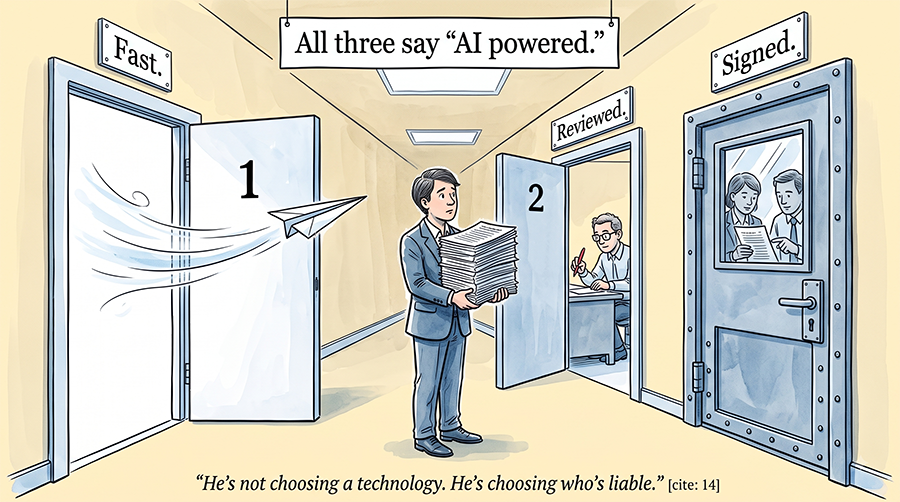 |
The short answer: raw machine output is acceptable for text nobody will act on and nobody will audit. Once a document carries legal, safety, or regulatory weight, a second trained reader is not a quality upgrade. It is the thing that makes the document usable at all.
We run three workflows at Alafranga. This page explains what each one actually does, and where each one fails.
We run three workflows at Alafranga. This page explains what each one actually does, and where each one fails.
| Raw machine output | SmartEdit | SmartEdit Pro | HumanExpert | |
| What happens | Engine output, no human step | AI draft generated inside memoQ or SDL Trados against the client TM and glossary, then reviewed by a subject specialist | Same as SmartEdit, with a second independent reviewer on terminology and compliance | Two independent specialists: one translates, one revises. No AI in the chain |
| Human involvement | None | One specialist reviewer | Two reviewers | Two linguists, full pass each |
| Translation memory and glossary | Not applied | Applied before generation, updated after | Applied and verified twice | Applied and maintained manually |
| Suitable for | Internal comprehension, ticket triage, first-pass reading of incoming documents | Product descriptions, technical manuals for known equipment, repeat content with mature TM, internal training material | CE and compliance documentation, marketing with legal exposure, medical device IFUs, high-volume regulated content | Contracts, court filings, arbitration bundles, patents, sworn and notarised documents, anything under regulatory audit |
| Regulatory and audit acceptance | None | Accepted where the client owns final sign-off | Meets ISO 17100 revision requirement | Meets ISO 17100 revision requirement, default for anything a court or notary will see |
| Typical throughput per day | Unlimited | 4,000 to 6,000 words | 3,000 to 4,000 words | 2,000 to 2,500 words |
| Indicative cost index | 5 | 55 to 65 | 75 to 85 | 100 |
| Where it fails | Turkish case endings, negation, and technical compounds. Confidently wrong output reads fluent | Source ambiguity the engine resolved incorrectly and the reviewer accepts as given | Cost approaches full human work on short jobs | Turnaround on large volume, cost on low-stakes content |
What actually breaks in Turkish
Turkish is agglutinative. Meaning that English carries in separate words is carried in Turkish by suffixes stacked onto a stem. A machine engine that drops or misplaces one suffix produces a sentence that is grammatically clean and factually inverted. We see this most often in three places:
Negation and obligation. Safety instructions written as "must not be operated without the guard in place" come back, more often than people expect, as text a Turkish technician reads as permission. In a machinery manual, that is not a language error. It is a liability.
Technical compounds. German source text compounds three or four concepts into one noun. The engine splits it, translates the parts, and produces a Turkish phrase that no Turkish engineer uses. Terminology sits in the glossary for exactly this reason, which is why we generate the AI draft inside memoQ or Trados against the client glossary rather than outside it.
False consistency. Machine output is consistent with itself and inconsistent with the client's approved terminology from three years ago. Without the translation memory applied before generation, every project restarts the terminology argument.
None of these are arguments against AI. They are arguments about where the AI draft is generated and who reads it afterwards.
The regulatory lineThere is a point where the choice stops being commercial and becomes a compliance question.
ISO 17100 requires that a second person revises the translation. Not a spell check, not a self review. A separate qualified person comparing source and target. Our SmartEdit Pro and HumanExpert workflows are built to that requirement. SmartEdit is not, and we say so when we quote it.
|
The EU Machinery Regulation 2023/1230 applies from 20 January 2027 and replaces the old Machinery Directive. Manufacturers placing machinery on the EU market are working through instruction sets, declarations, and safety information in every required language. That documentation will be read by market surveillance authorities. It is not SmartEdit content.
Turkish sworn and notarised translation has its own constraint: the sworn translator signs the document personally. There is no version of that process where unreviewed machine output carries a signature.
How we decide before quotingWe do not assign a workflow from the file type. We run a feasibility test first.
We take a representative extract, usually 500 to 1,000 words, generate the AI draft against the existing TM and glossary, and have the specialist mark what needed changing.
|
If the correction density is low and the terminology holds, SmartEdit is the honest recommendation and we quote it. If the specialist is rewriting rather than reviewing, we say the AI draft costs more than it saves and we quote HumanExpert.
This takes about half a day. It has saved clients more money than any rate negotiation we have had.
What this means if you are buyingIf you are a manufacturer with a mature terminology base and repeat documentation, SmartEdit will cut your cost roughly in half without touching quality, provided your TM is applied and maintained. If you are placing regulated documentation on the EU market, the workflow question is already answered for you.
|
If you are a language service company subcontracting Turkish, the useful question to ask a supplier is not whether they use AI. Everyone does. Ask where the draft is generated, whose TM it reads, and who signs off the revision step. The answers tell you what you are actually buying.
We started in Istanbul in 2002 with Turkish at the centre and the languages around it. The tools changed. The requirement that someone qualified reads the output before it leaves the building did not.
Frequently asked questions
Is AI translation acceptable for CE marking documentation?
Raw machine output is not. An AI assisted workflow with documented human revision by a second qualified person meets the ISO 17100 revision requirement and is used in regulated documentation. The distinction is the revision step, not the drafting method.
How much cheaper is AI assisted translation than fully human translation?
In our work, SmartEdit typically runs at 55 to 65 percent of the HumanExpert rate on content with a mature translation memory. On short jobs or unfamiliar subject matter the saving disappears, because the review effort approaches full translation effort.
Does ISO 17100 allow machine translation?
ISO 17100 covers human translation services and requires revision by a second person. Post-edited machine translation falls outside its core scope, which is why we distinguish our workflows explicitly rather than describing everything as ISO compliant.
Why does Turkish need more review than other languages in AI workflows?
Turkish is agglutinative and word order is flexible. Meaning that other languages carry in separate words is carried by suffix chains, so a single misplaced suffix can invert negation or obligation while leaving the sentence fluent. Fluent and wrong is harder to catch than clumsy and wrong.
Can you work inside our TMS or CAT environment?
Yes. We work in memoQ and SDL Trados 2024, and in Smartcat where a shared live TM across multiple translators is needed. We can work under your licences and in your project structure.
Further readings:
Why Translating from English into Turkish Is Harder Than Most Briefs Assume
Why Turkish Is Not Just Another European Language for Technical Translation
When Terminology Inconsistency Becomes a Real-World Problem
Why Turkish Legal Translation Demands Ongoing Legal Literacy
How to Choose a Turkish Translation Partner for Technical Documentation
Turkish Legal Translation Services
How to Get a Legal Turkish-to-English Translation: A Step-by-Step Guide
Turkey Has No National Translator Certification: Here Is What Buyers Should Know