▮Fluent is not the same as correct
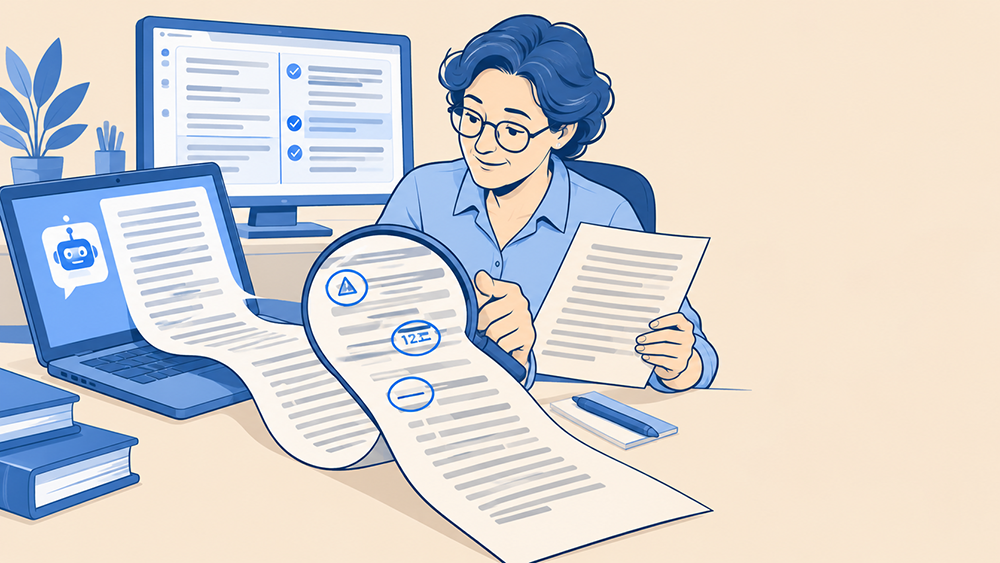
Machine translation used to fail visibly. Awkward sentences and broken grammar told the reader that something was wrong. Current AI output rarely fails that way. It reads naturally, and that is precisely what makes its errors hard to find. The problems we see most often in AI translations sent for review are these:
- Missing content. A sentence, a qualifier or a warning is simply absent, while the paragraph around it still reads well.
- Reversed meaning. A negation has been reversed, or a condition such as "unless" or "only if" has been softened.
- Changed figures. Numbers, units, tolerances or dates differ between source and target.
- Inconsistent terms. The same technical term appears in three different forms in one document, because the text was processed in separate chunks.
- Added text. Sentences that were not in the source have been added to make the target read more smoothly.
- Wrong register. A tone that suits marketing copy has been applied to a contract, a safety instruction or a patient leaflet.
None of these errors is visible to someone who reads only the target. Each of them is visible to someone who reads the target against the source, sentence by sentence.
▮What a chat window leaves out
A professional translation is normally produced in a CAT tool such as memoQ or Trados. The tool splits the text into segments, keeps every source sentence next to its translation, and applies a set of controls as a matter of course: the translation memory supplies previously approved sentences, the termbase flags the required terms, and automated QA checks numbers, tags, punctuation and omissions across the whole file.
An AI translation produced in a chat window has none of this. Formatting is often lost too: tables, headings and layout come back as plain text, and the document has to be rebuilt before it can be printed or filed. The translation may be good, but nothing in the workflow has confirmed that it is.
The same controls, side by side:
|
In a CAT workflow |
In a chat-window AI translation |
After alignment and review |
| Source and target pairing |
Every sentence kept next to its translation |
None; one block of text in, one out |
Restored segment by segment |
| Translation memory |
Approved earlier translations applied |
Not used |
Applied, and a new memory delivered |
| Termbase |
Required terms flagged in every segment |
Only if pasted into the prompt |
Applied and checked across the file |
| Automated QA |
Numbers, tags, omissions and terms checked |
None |
Run across the whole file |
| Formatting |
Original file format preserved |
Often returned as plain text |
Rebuilt in the original format through DTP |
| Record of how it was made |
Project history and reviewer names |
Model, prompt and inputs usually unknown |
QA report with every change by error type |
▮The questions nobody downstream can answer
The second loss is information. When an AI translation reaches a reviewer, the reviewer usually does not know which model or engine produced the text, what prompt or instructions it was given, whether a glossary, a style guide or earlier translations were supplied, or whether the document was translated as a whole or pasted in sections.
Each of these affects where errors are likely to be. A model given a glossary and the whole document behaves very differently from one given unrelated fragments with no instructions. Without this information, a reviewer has to treat every sentence as equally suspect, which takes longer and costs more.
▮How to make an AI translation reviewable
If your team translates with AI and intends to have the result checked, a few habits make the review faster and more reliable:
- Keep the pair. Store the source and the AI output together, in their original file formats.
- Record how it was made. Note the model, the date and the prompt used. A short note is enough.
- Share the same references. Give your glossary and approved earlier translations to the AI, and send the same material to the reviewer.
- Translate whole documents. Pasting sections separately is the most common cause of inconsistent terminology.
- Decide the risk in advance. Legal, safety and regulatory content needs a full review; internal material may need much less.
▮What an independent review does
At Alafranga, an AI translation sent for review goes through the same controls a translation project would. We first ask for the information listed above. Where it is not available, we review a sample section and tell you whether the file can be corrected or whether retranslation would be cheaper. When the AI output is poor enough that a reviewer would rewrite more than correct, post-editing costs more than starting again, and it is better to know that before the work begins.
Where you choose, the source and the AI target are then transferred into memoQ or Trados and aligned segment by segment. This restores what the AI workflow left out: your termbase, any existing translation memory and automated QA. It adds some cost, so for a one-off document many clients have the text reviewed directly in the file instead. In both cases, a specialist in the subject reviews each segment against the source for meaning, completeness, terminology and register, and numbers, units, omissions and term consistency are checked across the whole file. Where the layout has been lost, the document is rebuilt in its original format through DTP.
You receive the corrected file and a report that groups every change by error type. The report is often the most useful part: it shows where the AI went wrong and what to change in the prompt or the glossary next time. If the file was transferred into memoQ or Trados, you also receive the translation memory and termbase, so the next translation of the same content, whether by AI or by a person, starts from approved terminology.
If the same content will be translated again, it is often better to let us produce the AI draft in the first place. In AI-assisted translation, we read the whole text, build the glossary and prompts, test which engine performs best on your content and work in memoQ, Trados or an online translation platform from the start. Control, consistency and a reusable translation memory then come with the first delivery, not as an extra.
▮When AI drafting is enough, and when it is not
AI drafting is a reasonable choice for much internal and informational content, provided someone checks it at a level that matches the risk. It is a poor choice, without a full review, for contracts, regulatory submissions, safety instructions, medical documentation and anything that will be published under your name.
A quick way to place your own content:
| Content |
Examples |
What it usually needs |
| Internal and informational |
Internal notes, knowledge-base articles, first drafts |
Light post-editing |
| Customer-facing |
Websites, product documentation, marketing material |
Full post-editing |
| Regulated or legally binding |
Contracts, safety instructions, medical documentation, regulatory submissions |
Full post-editing with line-by-line source comparison, or retranslation |
| Poor AI output |
Text that needs more rewriting than correction |
Retranslation; it costs less than post-editing |
The question is not whether to use AI, but which content it can draft and which has to stay with a specialist. A short test on your own files usually answers that question better than any general rule.
▮Where we fit
Alafranga Language Solutions has provided translation since 2002, with Turkish as the founding language and more than 40 languages in our network, and operates to ISO 17100:2015. If you have an AI translation that needs checking before it goes out, send us the source, the AI output and whatever you know about how it was produced.
▮Frequently Asked Questions
- Can an AI translation be reviewed without the prompt or model information? Yes. The review is always carried out against the source text. Without information on the model and prompt, we start with a sample section to see where the errors are concentrated, and then agree the scope of the full review. Independent Review
- Do you always transfer the AI output into a CAT tool? No. Transferring the source and the AI output into memoQ or Trados places every sentence next to its translation and makes the termbase, translation memory and automated QA available, so omissions, changed figures and inconsistent terms are found systematically. It adds cost, so for a one-off document we often review directly in the file. We recommend the transfer when the content will be translated again or when the risk is high.
- What do we receive at the end of the review? The corrected file in its original format and a report with every change grouped by error type. If the output was transferred into memoQ or Trados, you also receive the translation memory and termbase for future translations of the same content.
- Is reviewing an AI translation always cheaper than a new translation? No. When the output requires more rewriting than correction, retranslation is cheaper. We assess a sample first and tell you which route costs less before work begins.
|

We worked directly with
Solplanet / AISWEI, Hoogendoorn Growth Management, Delta Plus Group, HI-REZ Studios, Yum! Brands, Subway, Toyota, Siemens Gamesa, Fluke, Faro, Xerox, TP-Link, OSCE, Umweltbundesamt, American Bar Association, Playata / European Games Group and many others across energy, horticulture, safety equipment, gaming, automotive, food, and public sectors since 2002.
Through our LSP partnerships, our work reaches pharmaceutical, technology, financial services, and media companies worldwide.
→ View our case studies
|
|

Tell us about your project
Send the file, the language pair, and your deadline. We will come back with a price, a delivery date, and which workflow we recommend for that content. You can start with a single document and expand from there. We reply within 1 working hour
→ Request a quote
|
ATC Accredited Member since 2007
ISO 17100:2015
General Data Protection Regulation
Founded in Istanbul, 2002
UK Registered as Alafranga Europe Ltd, Co. No: 16711244
|
|
Why a UK Certified Translation Might Not Work in Germany
Why Translating from English into Turkish Is Harder Than Most Briefs Assume
Why Turkish Is Not Just Another European Language for Technical Translation
When Terminology Inconsistency Becomes a Real-World Problem
Why Turkish Legal Translation Demands Ongoing Legal Literacy
How to Choose a Turkish Translation Partner for Technical Documentation
Turkish Legal Translation Services
How to Get a Legal Turkish-to-English Translation: A Step-by-Step Guide
Turkey Has No National Translator Certification: Here Is What Buyers Should Know
The Hidden Risk of Post-editing
Every Updated Manual Is a Retranslation Project